Most Ontario AC breakdowns during summer are preventable with a simple AC spring tune-up checklist. Replacing dirty filters, cleaning the outdoor condenser, flushing the drain line, and checking airflow before the first heat wave can improve efficiency, lower hydro bills, and help avoid costly emergency repairs. This guide walks Ontario homeowners through the most important steps in an AC spring tune-up checklist, warning signs of larger problems, and when it makes more financial sense to repair or replace the system before peak summer demand arrives.
Your AC spring tune-up checklist is the one thing standing between a cool, comfortable summer and a $400 emergency service call on the hottest weekend of the year.
Every May, thousands of Ontario homeowners flip their thermostat to “cool” for the first time since September — and hear nothing but a click. No cold air. Just a system that sat through five months of Canadian winter and quietly gave up.
Here is the part that stings: most of those breakdowns were completely preventable.
Your air conditioner is not like a car that refuses to start in January. The damage happens slowly — a drain line that grows algae all winter, condenser fins bent by ice, a capacitor that quietly degrades through freeze-thaw cycles. None of it shows until you actually need the system to run.
This guide gives you a step-by-step summer AC preparation plan written specifically for Ontario homes. Whether you have a central air conditioner from Lennox, Carrier, Trane, or Goodman — this checklist applies to you.
Before the Heat Hits — Why Ontario Homeowners Need This Checklist Right Now
Your Complete AC Spring Tune-Up Checklist — 7 Steps That Actually Matter
Work through these in order. Most steps take under 15 minutes and need no special tools.
Step 1: Replace Your Air Filter First — Not Last
This is the most skipped step in any AC spring tune-up checklist, and it causes more efficiency loss than almost anything else.
Your furnace filter has been collecting dust, pet dander, and debris since October. If your heating and cooling system shares the same air handler — which most Ontario homes do — that filter is likely choked before your AC even runs its first cycle.
What to do:
Pull the filter out and hold it up to a light source. If you cannot see light through it, replace it today.
For Ontario homes, a MERV 8 to MERV 11 filter gives you the right balance between air quality and airflow. Going too high (MERV 13+) on an older system restricts airflow and causes the evaporator coil to ice up.
Write the replacement date on the filter frame with a marker so you always know when it was last changed.
How often should you change your AC filter in Ontario?
Every 60 to 90 days during peak cooling season. If you have pets or a family member with allergies, change it every 30 to 45 days.
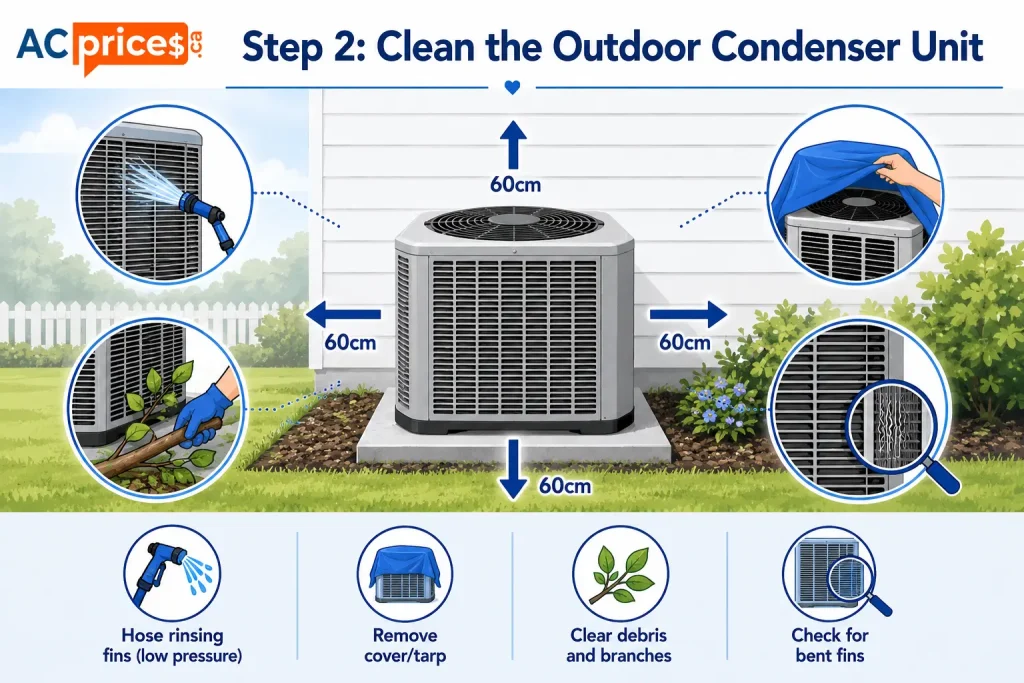
Step 2: Clean the Outdoor Condenser Unit
Your outdoor unit spent the last five months under snow, freezing rain, dead leaves, and whatever the winter left behind. Before you power it on, give it a proper inspection — skipping this is one of the leading causes of reduced cooling capacity in Ontario summers.
What to do:
Remove any cover or tarp placed on the unit over winter.
Clear at least 60 centimetres of open space on all four sides. Overgrown grass, shrub branches, and debris restrict airflow and force the compressor to work harder than it should.
Rinse the condenser fins using a garden hose at low pressure, spraying from the inside out. Never use a pressure washer — the aluminium fins are delicate and bend easily.
Look for visible damage: crushed fins, exposed wiring, signs of rodent nesting inside the cabinet, or rust on the base pan.
What if the fins are bent?
A fin comb from any HVAC supply store (roughly $15) straightens them out. Even 20% fin damage can reduce efficiency noticeably over an Ontario summer.
Step 3: Test the Thermostat on a Cool Day — Not During a Heat Wave
Do not wait until July 28th to find out your thermostat is not communicating with the system. Test it now, on a mild day, when you have time to troubleshoot without sweating through your shirt.
What to do:
Switch your thermostat to “cool” mode and set it 5°C below the current room temperature.
Wait two to three minutes. You should hear the outdoor unit click on. Within five to ten minutes, you should feel noticeably cooler air from the vents.
If the system does not respond, check the circuit breaker assigned to the AC. Reset it once. If it trips again immediately, stop — that is an electrical fault that needs a licensed technician.
Smart thermostat tip for Ontario homeowners:
If you are still using a manual dial thermostat, spring is an excellent time to upgrade. According to Natural Resources Canada, programmable and smart thermostats can reduce home cooling and heating costs by 10 to 15 percent annually. Most Ontario HVAC contractors can install one in under an hour.
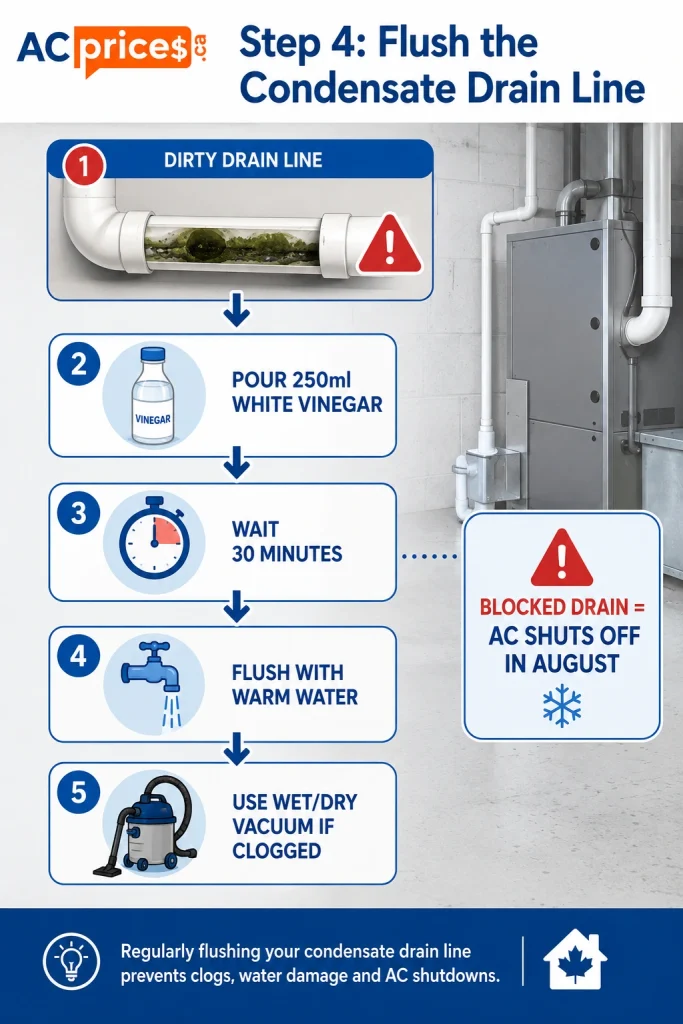
Step 4: Flush the Condensate Drain Line
This step causes more mid-summer AC shutdowns than almost anything else — and almost no one does it.
Your air conditioner pulls humidity out of the air and channels it out through a small PVC drain line. Over winter, algae, mold, and sediment build up inside that pipe. When it clogs in the middle of August, water backs up into the drain pan, triggers a safety float switch, and shuts your system off completely. Many homeowners assume the AC has broken down. Usually, it is just a blocked drain line.
What to do:
Find the condensate drain line. It is typically a 2 cm white or grey PVC pipe near your indoor air handler, leading to a floor drain or exiting the house through a wall.
Pour 250 ml of plain white distilled vinegar into the drain pan access point or directly into the pipe opening. Let it sit for 30 minutes.
Flush with warm water.
If the line seemed slow to drain or was visibly clogged, use a wet/dry vacuum on the exterior end of the pipe for about 60 seconds to pull the blockage out.
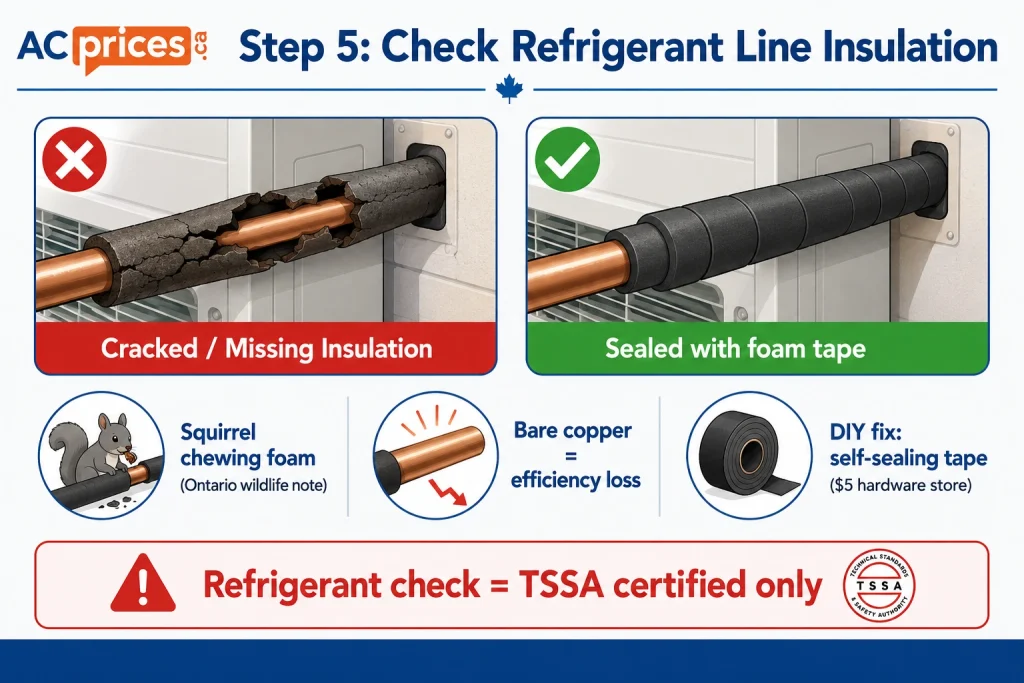
Step 5: Inspect the Refrigerant Line Insulation
The copper refrigerant lines running from your outdoor unit into the house should be wrapped in foam insulation — called a line set. Ontario winters are hard on that foam. It cracks, splits, peels away from the copper, and sometimes gets chewed by squirrels looking for nesting material.
What to do:
Walk the full path of the refrigerant lines from the outdoor unit to where they enter your home.
Look for bare copper sections, split foam, or missing insulation entirely.
Wrap any damaged sections with self-sealing foam pipe insulation tape, available at any hardware store for a few dollars. This is a 10-minute fix that prevents efficiency loss all summer.
Important: Do not attempt to check refrigerant levels yourself. In Canada, handling refrigerant requires certification under the Environmental Protection Act. If you suspect low refrigerant — signs include ice forming on the copper lines or warm air despite the system running continuously — call a TSSA-certified technician.
Step 6: Check Every Vent and Return Grille Inside the House
Airflow problems are almost never about the equipment itself. They are almost always about what is blocking air from moving freely through the house.
What to do:
Walk through every room and confirm all supply vents are fully open. Furniture pushed against vents, area rugs covering floor registers, and curtains draped over baseboard registers are the most common culprits.
Remove the return air grilles (the larger vents that pull air back to the system) and vacuum the inside edges. A thick layer of dust here is essentially your system gasping for air.
Do not close vents in unused rooms to “save energy.” In a central air system, closing vents increases duct pressure and forces the blower to work harder, which shortens its lifespan and raises your hydro bill.
Step 7: Book a Professional HVAC Inspection — Now, Before Everyone Else Does
“We start getting slammed with calls around the May long weekend,” says James Kovacs, an HVAC technician with 14 years of experience in the Hamilton-Burlington corridor. “Homeowners who call in April or early May for an AC spring tune-up checklist inspection get priority scheduling and pay standard rates. By mid-June we are typically booked two weeks out and emergency rates start to apply.”
A professional spring inspection covers what you cannot check yourself: refrigerant charge, capacitor health, electrical connections, evaporator coil condition, and compressor performance. In Ontario, most HVAC companies charge between $90 and $150 for a tune-up visit — a fraction of what a mid-July emergency call costs, which can easily run $300 to $500 before parts.
What Ontario’s Climate Does to Your AC That Other Provinces Don’t Deal With
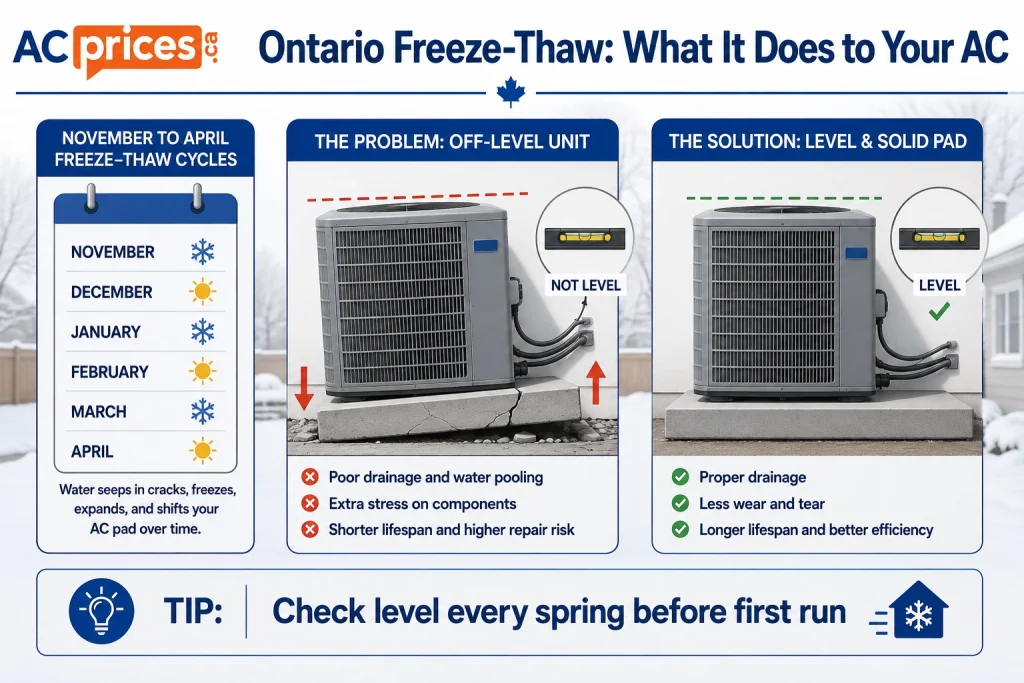
Freeze-Thaw Damage to the Base Pad
Southern Ontario gets repeated freeze-thaw cycles between November and April — sometimes dozens of them in a single winter. This shifts the concrete or composite pad your outdoor unit sits on, and a tilted unit stresses the compressor and refrigerant connections over time.
Use a standard bubble level to check that your unit is sitting level before you run it. A unit that has shifted more than a few degrees should be re-leveled before the season starts.
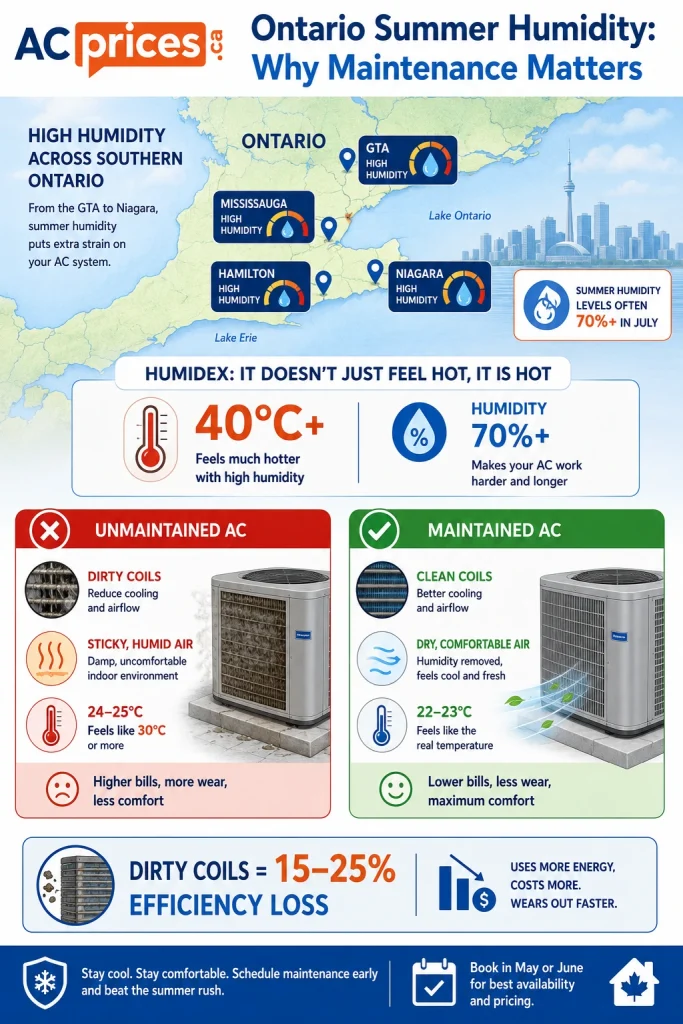
High Humidity Loads in the GTA and Niagara Region
Toronto, Mississauga, Hamilton, and the Niagara area regularly see humidex values above 40°C in July and August. A properly maintained air conditioner dehumidifies as it cools — this is not a secondary function, it is central to why the space feels comfortable.
An unmaintained unit with dirty coils or low refrigerant stops dehumidifying effectively, leaving your home feeling sticky and muggy even at 22°C. If that sounds familiar from last summer, a dirty evaporator coil is the most common cause.
Ontario summers have become increasingly humid in recent years, especially across the GTA and Niagara region. Environment Canada weather forecasts
Estimate Your Summer Cooling Costs
Ontario humidity and rising electricity rates can significantly impact monthly cooling bills.
Use our AC Operating Cost Calculator to estimate how much your air conditioner costs to run during peak summer months.
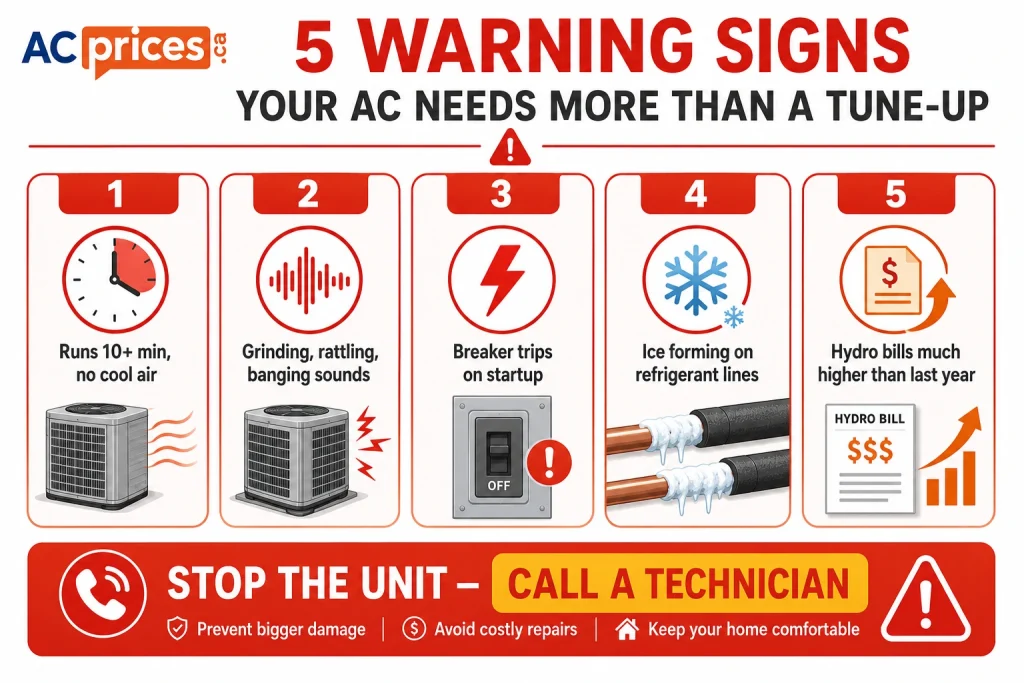
Signs Your AC Needs More Than a Tune-Up This Spring
Complete your checklist — but also watch for these signals that something more serious is wrong:
The system runs for more than 10 minutes and does not produce noticeably cool air
You hear grinding, rattling, banging, or a high-pitched squeal during startup
The circuit breaker trips the moment the AC turns on
Ice forms on the refrigerant lines within 15 minutes of operation
Your hydro bills last summer were significantly higher than the year before with no change in usage habits
Not Sure What’s Wrong With Your AC?
Strange noises, weak airflow, warm air, or constant cycling? Use our AC Troubleshooting Wizard to identify common air conditioner problems before booking a repair visit.
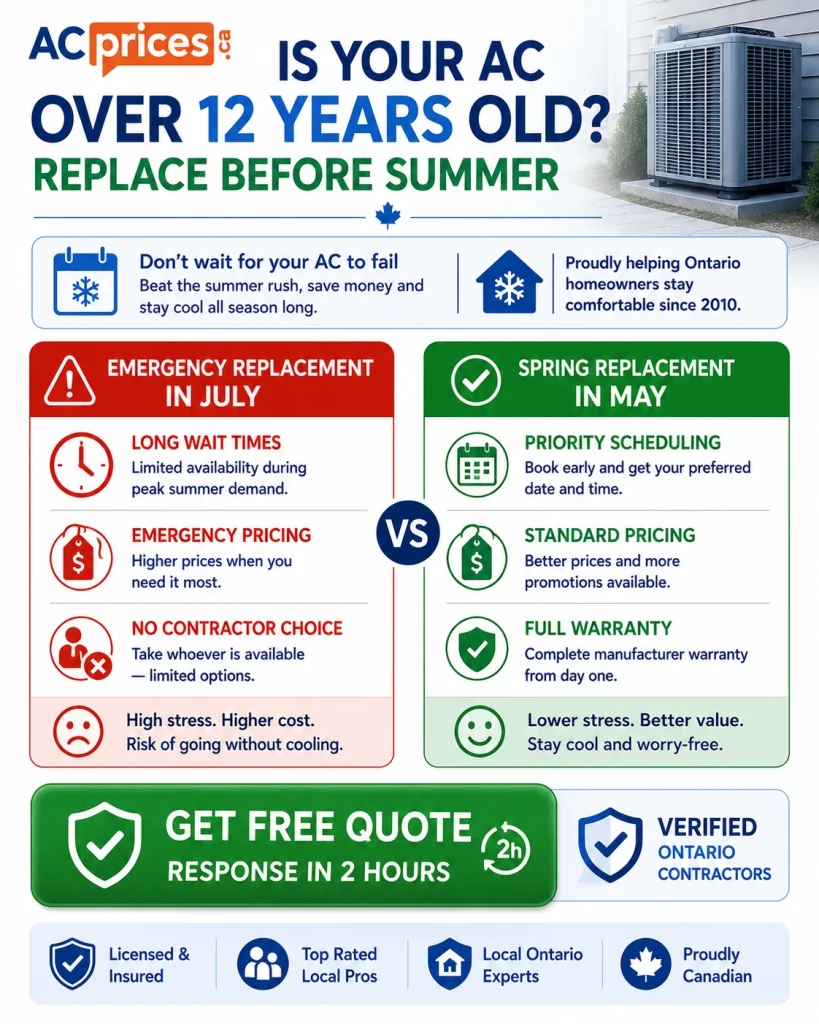
Not sure if repair is worth it? If your unit is more than 12 years old, the math often tilts toward replacement — especially when you factor in Ontario’s rising hydro rates and the efficiency difference between a 10-SEER unit from 2011 and a 16-SEER or higher unit today. 👉 Read: Signs you need to replace your air conditioner in Canada →
Estimate Your Cooling Cost Savings
Wondering how much you could save with a newer high-efficiency air conditioner?
Use our AC Savings Calculator to compare your current system with modern ENERGY STAR® models and estimate yearly hydro savings in Ontario.
Compare AC Quotes Before Summer — No Obligation, No Rush
If your system is over 12 years old, or if this AC spring tune-up checklist inspection surfaces a repair estimate over $800, replacing the unit before it fails completely is almost always the smarter financial decision. Additionally, Ontario homeowners who replace in May or early June avoid emergency pricing, get full contractor attention, and start the summer with a warranty-backed system from day one.
Get your free quote from verified local HVAC contractors in Ontario. Response within 2 hours. No pressure, no obligation.
Choosing the wrong AC size can increase hydro bills, reduce comfort, and shorten system lifespan. Use our AC Size & Tonnage Calculator to estimate the right cooling capacity for your Ontario home.
Q1: When is the best time to do my AC spring tune-up in Ontario?
Late April to mid-May is ideal — before summer heat waves and peak HVAC booking season begin.
Q2: Can I do the spring AC tune-up myself, or do I need a professional?
Yes. Tasks like filter replacement, condenser cleaning, thermostat testing, and drain flushing are DIY-friendly. Refrigerant and electrical work should be handled by a licensed technician.
Q3: How much does an AC tune-up cost in Ontario in 2026?
Most Ontario AC tune-ups cost between $90 and $150 depending on the service included.
Q4: My AC worked perfectly last summer. Do I still need a tune-up?
Yes. Winter moisture, freeze-thaw cycles, and inactivity can still cause issues before summer starts.
Q5: How do I know if my AC is low on refrigerant?
Common signs include ice on refrigerant lines, weak cooling, long run times, or warm air from vents.
Q6: What happens if I skip the spring tune-up?
Skipping maintenance can reduce efficiency, increase hydro bills, and lead to costly summer breakdowns.
Q7: Is spring a good time to replace an old AC unit in Ontario?
Yes. Spring offers better scheduling, possible promotions, and avoids peak-season emergency pricing.
Q8: Does my warranty require annual professional maintenance?
Usually yes. Many brands require yearly professional maintenance to keep warranty coverage valid.
 Canadian