Written by the acprices.ca Team Reviewed by HVAC Professional, Licensed HVAC Technician
Running your air conditioner in Canada costs more than most homeowners expect — and the gap between an efficient setup and an inefficient one can mean hundreds of dollars every summer. Understanding your AC Running Cost in Canada is essential whether you’re budgeting for a new system or trying to reduce your current electricity bills.
This guide breaks down the real numbers, energy usage, and key factors that affect what Canadians actually pay to stay cool each summer.
Where These Numbers Come From
The cost ranges in this guide are calculated using Statistics Canada
electricity pricing data and manufacturer wattage specs for common AC
sizes. Provincial rate figures are sourced from Hydro-Québec, Ontario
Energy Board, and other provincial utility rate schedules — see
citations below.
How Much Does It Cost to Run an Air Conditioner in Canada?
The short answer: running central air conditioning in Canada typically costs between $50 and $250 per month during summer, depending on your province, system size, and usage habits.
Here’s a quick breakdown by AC type:
AC Type
Typical Wattage
Est. Monthly Cost
Window AC (small room)
500–1,000 W
$10–$75
Portable AC
900–1,400 W
$10–$50
Ductless Mini-Split
500–2,000 W
$50–$200
Central AC (whole home)
3,000–5,000 W
$75–$250
Not sure what size AC your home needs? Use our AC Size & Tonnage Calculator to find the right fit before estimating costs.
Air Conditioner Running Cost Calculator: The Formula
To calculate your exact AC running cost, you need three numbers:
AC wattage (found on the unit label or spec sheet)
Daily hours of use
Your local electricity rate (cents per kWh — see the table below)
Formula:
Cost per day = (Wattage ÷ 1,000) × Hours Used × Electricity Rate ($/kWh)
Example: A 4,000-watt central AC running 8 hours/day in Ontario at $0.141/kWh:
(4,000 ÷ 1,000) × 8 × $0.141 = $4.51 per day → ~$135/month
Want to skip the math? Our AC Operating Cost Calculator does this instantly — just enter your system size and province.
Step 1 of 70%
⚡
Air Conditioner Operating Cost Calculator
Calculate the estimated monthly and annual operating cost of your air conditioner based on your usage, climate, and electricity rate.
What type of air conditioner do you have?
What is the size of the area you are cooling?
How well insulated is your space?
What is your climate region?
What temperature do you set your thermostat to?
Thermostat setting affects how hard your AC works.
22°C
17°C27°C
What is your average electricity rate? ($/kWh)
Check your electricity bill for your rate. Average is $0.12–$0.15/kWh.
$0.13/kWh
0.07/kWh0.3/kWh
Would you like to receive a free no-obligation estimate from our local contractor partners as well?
Great! Almost done, your result is on the next page.
Please enter your contact details so our Certified contractors can provide estimates as well.
This field is required.
Please enter a valid email address.
Please enter your phone number.
Please enter your city or postal code.
By submitting this form, you are giving your consent to receive phone calls and text messages from our contractor partners.
You're almost done!
Please provide your details to see your results.
Name is required.
Email is required.
Please enter your city or postal code.
⚡ Costs Calculated
Your AC Operating Costs
Monthly Cost
—
Annual Cost
—
Reduce Your Energy Costs
A properly sized, high-efficiency AC keeps operating costs low. Get free quotes from certified contractors.
Electricity Rates by Province: What Canadians Actually Pay (2025)
Your province is one of the biggest factors affecting your total AC Running Cost in Canada. Quebec homeowners often pay a fraction of what Alberta residents pay for the exact same cooling usage because electricity rates vary significantly across the country.
Province/Territory
Cost per kWh
Quebec
7.8¢
Manitoba
10.2¢
British Columbia
11.4¢
New Brunswick
13.9¢
Ontario
14.1¢
Newfoundland & Labrador
14.8¢
Nova Scotia
18.3¢
Prince Edward Island
18.4¢
Yukon Territory
18.7¢
Saskatchewan
19.9¢
Canada Average
19.2¢
Nunavut
35.4¢
Northwest Territories
41.0¢
Alberta
25.8¢
Source: Provincial utility rate schedules (Hydro-Québec, Manitoba Hydro, BC Hydro, Ontario Energy Board, Nova Scotia Power, SaskPower, ATCO/EPCOR) as of [rate effective date]. Rates reflect average residential tiered/flat rates and may vary by usage tier or time-of-use period.
Real-world comparison: Running the same 3.5-ton central AC for 8 hours/day costs approximately:
Quebec: ~$2.18/day ($65/month)
Ontario: ~$3.95/day ($118/month)
Alberta: ~$7.22/day ($217/month)
Ontario homeowners note: Time-of-use (TOU) pricing means running your AC during off-peak hours (evenings and weekends) can cut daily costs by 30–50%. Check out our Oakville HVAC rebates guide for provincial incentive programs.
AC Running Cost by Size (BTU Rating)
Matching your AC size to your space is critical. An undersized unit runs constantly and drives up your bill; an oversized unit short-cycles and fails to control humidity.
AC Size (BTU)
Power Draw
Cost/Hour*
5,000 BTU
500 W
$0.10
6,000 BTU
600 W
$0.12
8,000 BTU
800 W
$0.15
10,000 BTU
1,000 W
$0.19
12,000 BTU
1,200 W
$0.23
14,000 BTU
1,400 W
$0.27
15,000 BTU
1,500 W
$0.29
18,000 BTU
1,800 W
$0.35
*Based on Canada average rate of 19.2¢/kWh
For a 1,400 sq ft house: You'll typically need a 2–2.5 ton (24,000–30,000 BTU) central AC unit. At Ontario rates, this runs approximately $0.45–$0.57/hour to operate, or roughly $3.60–$4.56 for an 8-hour day.
Not sure what size you need? Our AC Size & Tonnage Calculator gives you a precise recommendation based on your square footage, ceiling height, and insulation type.
Step 1 of 30%
📐
A/C Size Calculator
This short quiz is designed to help homeowners estimate the correct central air conditioning system size and BTU rating for your home.
Select your home type
Approximate home square footage of finished living space
Would you like to receive a free no-obligation estimate from our local contractor partners as well?
Great! Almost done, your result is on the next page.
Please enter your contact details so our Certified contractors can provide estimates as well.
This field is required.
Please enter a valid email address.
Please enter your phone number.
Please enter your city or postal code.
By submitting this form, you are giving your consent to receive phone calls and text messages from our contractor partners.
You're almost done!
Please provide your details to see your results.
Name is required.
Email is required.
Please enter your city or postal code.
📐 Size Calculated
Your Recommended AC Size
Recommended Tonnage
—
BTU Output
—
Get a Confirmed Size from a Pro
A certified HVAC contractor performs a Manual J load calculation for exact sizing.
SEER Rating: The Biggest Factor Most Homeowners Overlook
Your air conditioner’s SEER (Seasonal Energy Efficiency Ratio) rating has a major impact on your total AC Running Cost in Canada. Higher SEER systems use less electricity to produce the same amount of cooling, which can significantly reduce long-term operating costs and summer hydro bills.
Lifetime cost comparison for a 3-ton unit running 2,100 cooling hours at $0.11/kWh:
SEER Rating
Estimated Lifetime Cost
SEER 8 (older system)
~$13,500
SEER 16 (standard efficient)
~$7,500
SEER 23 (high efficiency)
~$5,000
Calculation basis: 3-ton (36,000 BTU) system, 2,100 cooling hours per year, 15-year system lifespan, $0.11/kWh electricity rate. Actual lifetime costs vary with local electricity rates, climate, and usage patterns — use our AC Savings Calculator for a figure based on your own SEER rating and location.
The difference between keeping an old SEER 8 unit and upgrading to a SEER 16 model: over $6,000 in electricity savings over the system's life.
Want to see how much a more efficient unit could save you? Try our AC Savings Calculator — enter your current SEER rating and see the payback timeline.
Minimum SEER requirements in Canada have been rising. If your unit is more than 10 years old, it's likely operating at SEER 10 or below. An HVAC professional can assess whether replacement or repair makes more financial sense.
Hourly, Daily, and Seasonal AC Cost Breakdown
Cost Per Hour
Central AC (3.5 kW) in Ontario: ~$0.49–$0.59/hour depending on TOU pricing
Ductless mini-split (1.2 kW) in Ontario: ~$0.17–$0.20/hour
Window AC (1.0 kW): ~$0.10–$0.19/hour depending on province
Cost Per Day (Central AC, Ontario)
Peak hours (11am–5pm weekdays): ~$6.37/day
Mid-peak hours: ~$4.27/day
Off-peak (overnight/weekends): ~$3.05/day
Seasonal Cost (May to September)
Depending on your province, system, and habits:
Small home, efficient system, cooler province: $150–$300/season
Average Canadian home: $400–$600/season
Large home, older system, hot province: $700–$1,000+/season
7 Key Factors That Affect Your AC Running Cost
1. Thermostat Settings
Each degree lower forces your AC to work significantly harder. According to Natural Resources Canada, raising your thermostat 4–6°C when you're away for 8 hours can reduce annual cooling costs by up to 10%. Setting to 25°C instead of 22°C during the day makes a noticeable difference without sacrificing comfort.
Smart thermostats automate this — they're one of the fastest-payback investments for Canadian homeowners.
2. Outdoor Temperature and Humidity
When outdoor temps rise by 20°F, compressor power consumption increases by approximately 25% while total cooling capacity drops 13%. Urban homeowners face the additional "heat island" effect — cities can run 2–5°C hotter than surrounding rural areas, meaning your AC works harder for the same indoor temperature.
High humidity further increases AC Running Cost in Canada because your system must remove moisture from the air in addition to lowering the temperature.
3. Home Size and Insulation
A well-insulated 1,500 sq ft home can cost less to cool than a poorly insulated 1,000 sq ft home. Key factors:
Insulation quality (attic insulation has the highest ROI)
Window type and placement (south/west-facing windows gain significant heat)
Ceiling height (higher ceilings = more air volume to cool)
Age of home (older homes often have significant air leakage)
4. Installation Quality and Ductwork
Poor installation can reduce AC efficiency by up to 30%. Improperly sealed ductwork wastes 20–30% of cooled air before it reaches your living spaces. This is one of the most common hidden cost drivers in Canadian homes with older HVAC systems.
A dirty air filter alone can increase energy consumption by 5–15%. Annual professional maintenance — cleaning coils, checking refrigerant, inspecting electrical connections — keeps your system at peak efficiency.
6. AC Type and System Configuration
Central AC systems cool the entire home through ductwork, making them a practical choice for larger houses, though they can increase overall AC Running Cost in Canada if the system is older or inefficient.
Mini-split systems are typically more energy-efficient on a room-by-room basis, but whole-home coverage may require multiple indoor units. Window and portable AC units are the most cost-effective option for cooling single rooms only.
7. Time-of-Use Pricing
In Ontario, when you run your AC matters as much as how long you run it. Shifting usage to off-peak hours (evenings and weekends) can reduce daily cooling costs by 30–50%.
AC Type Comparison: Costs and Best Use Cases
Type
Purchase Cost
Monthly Running Cost
Best For
Window AC
$175–$800
$10–$75
Single rooms, renters
Portable AC
$300–$700
$10–$50
Rooms without windows, temporary use
Ductless Mini-Split
$4,000–$8,000+
$50–$200
Additions, zoned cooling, no-duct homes
Central AC
$3,500–$7,000
$75–$250
Whole-home cooling, existing ductwork
10 Proven Ways to Reduce Your AC Running Cost
Replace filters every 1–3 months — dirty filters are the #1 cause of reduced efficiency
Use a programmable or smart thermostat — raise the setpoint 4–6°C when away for 8+ hours
Close blinds on south and west-facing windows — can reduce solar heat gain by up to 77%
Run ceiling fans — allows thermostat to be set 2–3°C higher with the same perceived comfort
Avoid heat-generating appliances during peak hours — ovens, dishwashers, and dryers all add indoor heat load
Seal duct leaks — professional duct sealing can improve efficiency by 20–30% in older homes
Schedule annual professional maintenance — keeps efficiency at rated levels and extends system life
Use exhaust fans when cooking or showering — removes heat and humidity before it spreads
Check for and seal air leaks — weatherstripping and caulking windows/doors reduces load significantly
Consider a heat pump — modern heat pumps provide both heating and cooling at higher efficiency than traditional AC
See exactly how much you could save: Use our AC Savings Calculator to compare your current usage against an optimized scenario.
When to Repair vs. Replace Your AC
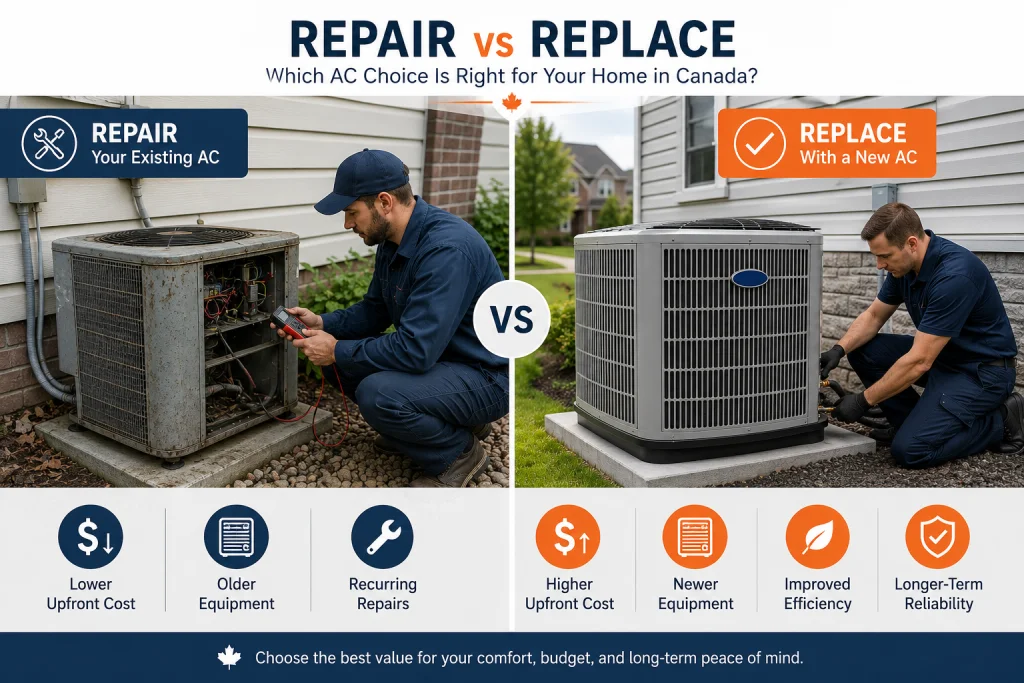
If your system is over 10 years old and repair costs are approaching 50% of replacement cost, replacement is usually the smarter financial decision — especially when you consider how much newer high-efficiency systems can reduce your overall AC Running Cost in Canada over time.
Signs your AC may need attention:
Energy bills increasing year-over-year without changes in usage
Uneven cooling or humidity problems
Frequent cycling on and off
Unusual noises or refrigerant leaks
Unsure if a repair or full replacement makes more financial sense? Our ACRepair Cost Calculator can help you compare the numbers before calling a technician.
Q1: How much does it cost to run central air conditioning per hour in Canada?
A standard 3.5-ton central AC running in Ontario costs approximately $0.49–$0.59 per hour, depending on time-of-use pricing. In Quebec (lower rates), the same unit costs around $0.27/hour. In Alberta (higher rates), expect $0.91/hour or more.
Q2: Is it cheaper to leave the AC on all day or turn it on and off?
Leaving the AC at a constant temperature is generally less efficient than raising the setpoint when you're away. A programmable thermostat that raises the temperature 4–6°C during work hours and cools down before you return is the most cost-effective approach.
Q3: What does it cost to run central air conditioning for a whole summer in Canada?
For an average Canadian home (1,500–2,000 sq ft), expect $300–$700 for a full May–September cooling season. Homes in hotter regions, with older systems, or with high electricity rates (Alberta) can see costs above $1,000.
Q4: How much does an average central air conditioner cost per month in Ontario?
In Ontario, a typical 3-ton central AC running 8–10 hours per day costs approximately $100–$150/month during summer months, with costs varying by time-of-use pricing tier.
Q5: Do mini-splits really cost less to run than central AC?
Per square foot cooled, yes — ductless mini-splits are typically more efficient because there's no duct loss. However, for whole-home cooling, you'd need multiple units, and total cost depends on your home layout and how many zones you need.
Q6: How can I check if my AC is running efficiently?
Track your monthly kWh usage on your electricity bill and compare it to similar months in previous years. A sudden increase without changes in behavior usually points to a maintenance issue. An HVAC professional can also perform an efficiency test.
Summary: What You'll Pay to Run AC in Canada
Scenario
Daily Cost
Monthly Cost
Seasonal Cost
Small room window AC, Quebec
$0.17
$5
$25–$50
1-bedroom mini-split, Ontario
$1.20
$36
$180
2-bedroom central AC, Ontario
$3.50–$4.50
$105–$135
$525–$675
3-bedroom central AC, Alberta
$6.50–$8.00
$195–$240
$975–$1,200
The most impactful variables in order: electricity rate → system SEER rating → thermostat habits → maintenance quality → home insulation.
Get Expert Help With Your AC Costs
Understanding your AC running costs is the first step — but choosing the right system, sizing it correctly, and having it professionally installed is what produces real long-term savings.
 Canadian