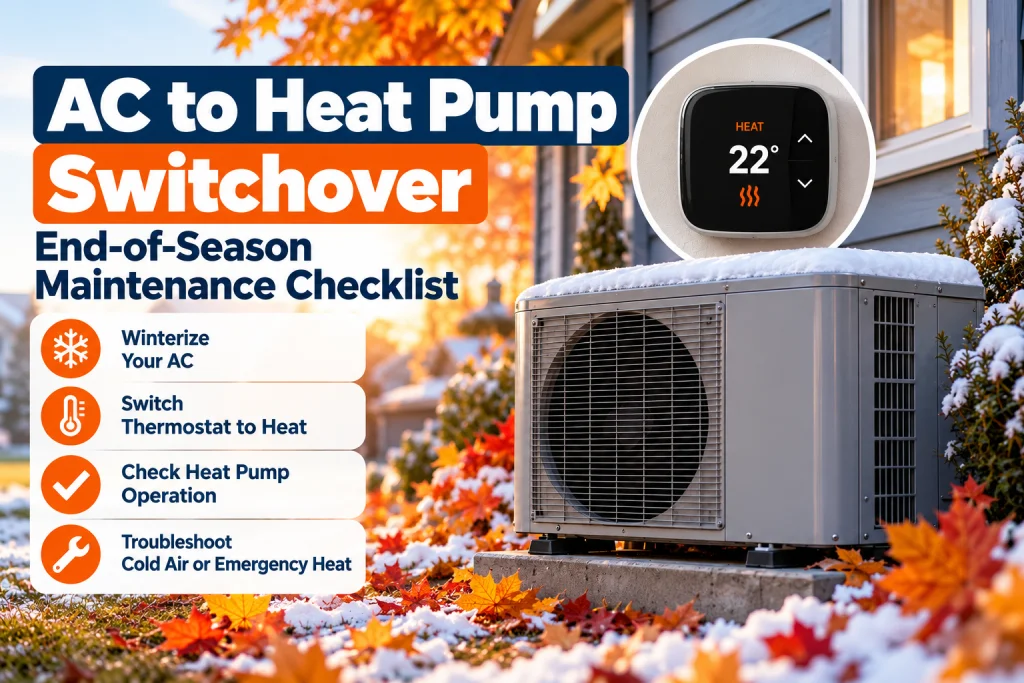
Switching from AC to heat is about a 30-minute fall job in most Ontario homes: shut down cooling, set the thermostat to Heat, and confirm warm air reaches every room before the first hard frost. What you do outside depends on your system. A cooling-only central AC can be cleaned and shut down for winter. A heat pump stays powered and uncovered, because it is your heater.
This AC to heat pump switchover checklist covers central AC with a gas furnace, all-electric heat pumps, and dual-fuel systems that pair the two. Find your system in the first table, work through the 8 steps, then use the troubleshooting sections if something doesn’t heat the way it should this fall.
By the ACPrices.ca Editorial Team•✔ Sources checked: October 2026•Updated: October 2026
What Does Your System Need for Winter?
Your System
What to Do for Winter
Central AC + gas furnace
Stop cooling, clean the outdoor unit, cover the top only if you choose to, replace the filter and test the furnace.
Heat pump (all-electric)
Keep the outdoor unit powered and uncovered, clear debris, replace the filter and test heating.
Dual-fuel (heat pump + furnace)
Treat the outdoor unit as a heat pump: powered and uncovered. Ask your installer at what outdoor temperature the furnace takes over.
If your system isn’t heating properly after the switch, the Heat Pump Troubleshooting Wizard can point to the likely cause before you book a service call.
Not Sure Whether You Have a Central AC or a Heat Pump?
The outdoor units look almost identical, so check the thermostat and wiring before you touch anything. One of the costliest fall mix-ups is a heat pump owner following AC winterization advice, wrapping the unit in a tarp, and then wondering why the house won’t heat in December.
Clue
Central AC + Furnace
Heat Pump (or Dual-Fuel)
Thermostat shows “Aux Heat” or “Em Heat”
No
Usually yes
An O, B or O/B wire on the thermostat
No
Yes, it controls the reversing valve
Outdoor unit runs in January
No, it sits idle
Yes, it is moving heat indoors
Steam from the outdoor unit on frosty days
Never
Normal during defrost
Can you cover it for winter?
Optional, top only
Never
Still unsure? The model number on the outdoor unit’s data plate will tell you. Search it with the brand name, or ask your installer. If your cooling system was replaced recently, check the paperwork too: a dual-fuel system looks almost the same from the backyard as a central AC.
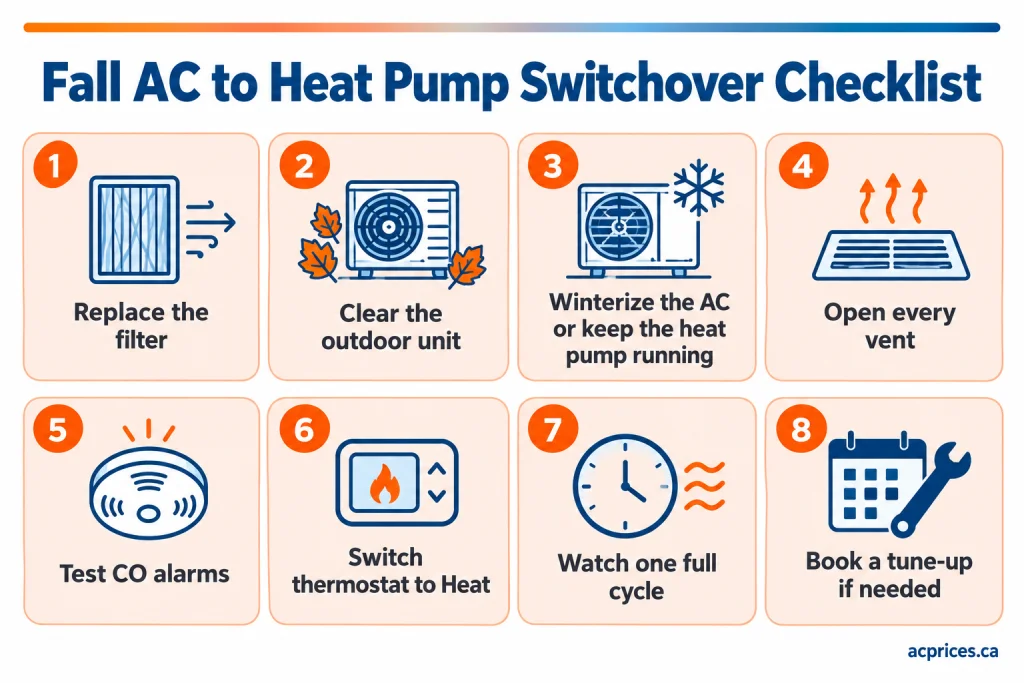
The 8-Step Fall Switchover Checklist
Applies to: all systems. Step 3 depends on your system.
Work through these in order on a mild day, ideally before overnight lows settle below freezing. On a system with no faults, it takes about half an hour.
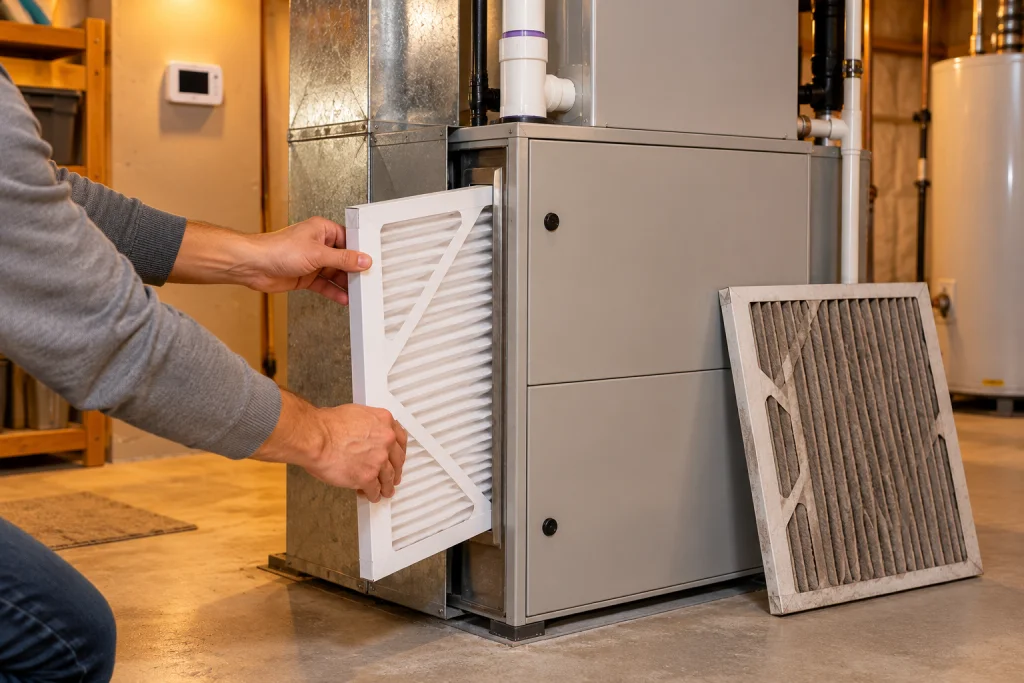
Replace the furnace or air handler filter. Summer pollen and dust load it up. A clogged filter cuts airflow and efficiency, which is why NRCan recommends changing or cleaning it every three months.
Clear the outdoor unit. Remove leaves, grass clippings and stored patio furniture from around it. Trim plants back so air can move freely.
Winterize the AC or keep the heat pump running. Cooling-only AC: follow the cover, drain and water steps in the next section. Heat pump or dual-fuel: leave the unit powered and uncovered.
Open every supply and return vent. Pull furniture and rugs off registers. Closing vents in unused rooms raises duct pressure and can make a heat pump struggle.
Test your carbon monoxide alarms. Anyone with a gas furnace or dual-fuel system needs working CO alarms near sleeping areas, as Health Canada advises.
Switch the thermostat from Cool to Heat. Set it about 2°C above room temperature so it calls for heat right away.
Watch one full heating cycle. Warm air should reach the farthest room within 10 to 15 minutes. A faint dusty smell on a furnace’s first run of the season is normal and fades quickly.
Book a heating tune-up if anything seems off. Scheduling it while the weather is mild gives you more appointment choice than waiting for a breakdown on the first cold night.
Doing the matching job in spring? Our AC spring tune-up checklist for Ontario reverses this process and covers the start-up checks your AC needs after a winter outside.
How Do You Winterize a Central AC? Cover, Drain and Water Line Shutdown
Applies to: cooling-only central AC. Heat pump owners can skip to the box at the end of this section.
Winterizing a central AC means cleaning it, keeping falling ice off the top, and making sure no water can freeze around it. Our air conditioner maintenance tips cover the rest of the yearly care routine.
Should You Cover Your AC for Winter?
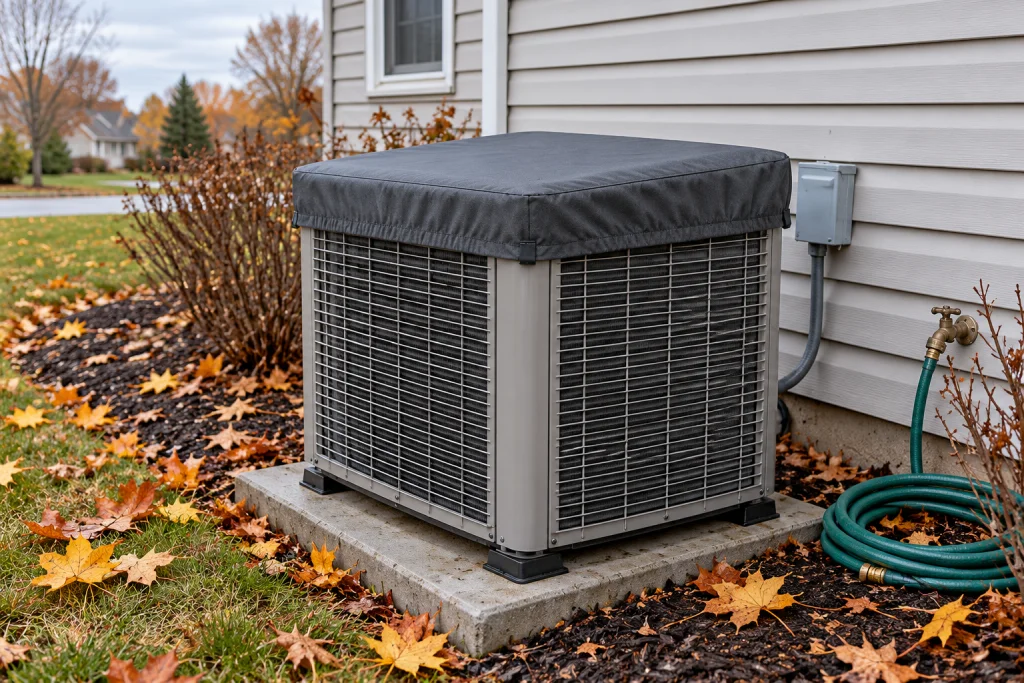
A cover is optional. Outdoor units are built to sit outside year-round, and some manufacturers advise against covering them, so check your installation manual first. If you do cover it, switch off power at the outdoor disconnect, rinse leaves and cottonwood fluff out of the fins with a gentle stream from a garden hose (never a pressure washer), and let the unit dry. Then fit a breathable cover or a piece of plywood weighted on the top only. Never wrap the sides in a plastic tarp. A fully sealed unit traps condensation, rusts from the inside, and gives mice a warm place to chew wiring.
Leaving the disconnect off for the winter is also optional for a cooling-only AC, but it stops the unit starting on a mild November afternoon. If you do, write a note on your spring calendar: restore power about a day before the first start-up, because many compressors rely on a crankcase heater to warm the oil before running. Your installation manual will confirm whether yours has one.
What Should You Drain Before Winter?
The water you need to deal with is condensate, not refrigerant. All summer, the indoor coil above your furnace drips into a pan and a small drain line. Pour a cup of warm water into the pan or the line’s access tee and confirm it flows to the floor drain or pump. A slow drain in October becomes a musty smell and a clog next June.
If you have a high-efficiency furnace, its own condensate line keeps working all winter. Check that the trap isn’t cracked and the condensate pump (if you have one) switches on when you lift its float.
Outdoor Faucets and Furnace Humidifiers: What to Check Before Winter
A central AC has no water supply of its own, which is where a lot of online advice gets muddled. The two water items to check at switchover time are near it, not in it:
Outdoor faucet (hose bib): shut it off. Close the indoor shut-off valve, open the outdoor tap to drain it, and disconnect the hose you used to rinse the condenser. A frozen, split hose bib next to the unit can coat the coil in ice.
Furnace humidifier: turn it on. If a bypass humidifier is mounted on your ductwork, open its water supply valve and move the bypass damper to the winter position. Lower the humidistat as outdoor temperatures fall, or your windows will sweat.
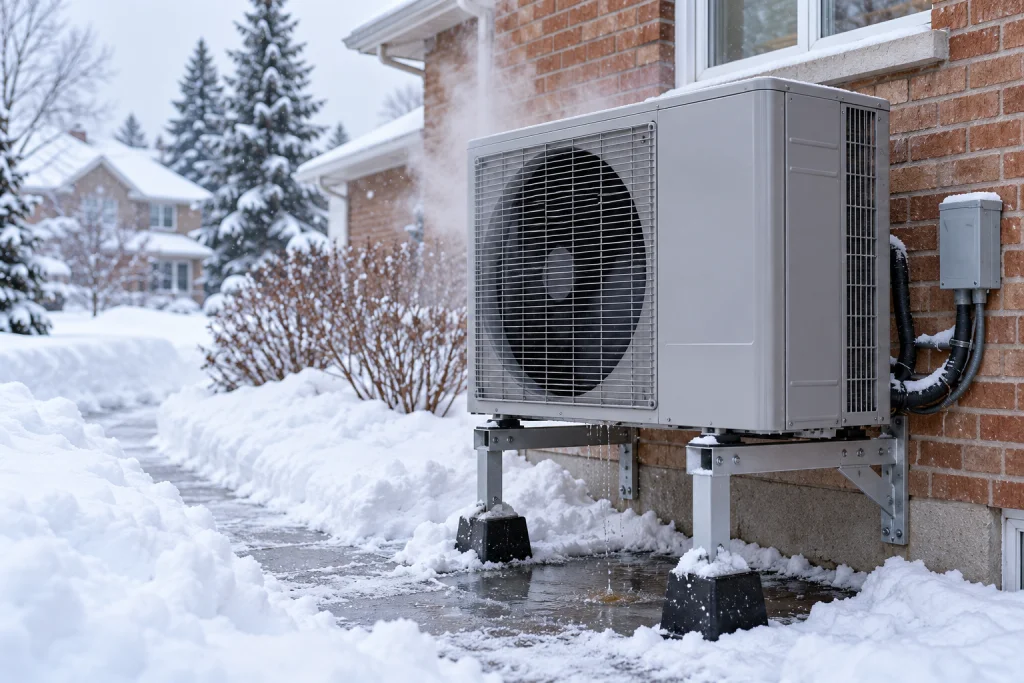
⚠️ Heat pump owners, skip the cover. Your outdoor unit runs all winter and needs open airflow plus a clear path for defrost meltwater to drain. Never cover it, never switch off its disconnect, and brush snow off the top and sides after every storm.
Why Won’t My Thermostat Switch From Cool to Heat?
Applies to: all systems. The O/B setting applies to heat pumps only.
Most changeover problems are settings, not broken parts. Work down this list before you call anyone:
Wait out the delay. Many thermostats hold the compressor off for about five minutes after a mode change to protect it. Nothing happening for a few minutes is normal.
Check schedules and eco modes. Smart thermostats often keep a summer schedule that quietly switches back to Cool, or an away mode that holds the house at 16°C.
Replace the batteries or check the C-wire. A weak display, random reboots or a blank screen at night usually means low power, not a bad thermostat.
Confirm the system type. If you replaced the thermostat this summer, it may be set up as “conventional” when you have a heat pump. It then never energises the heat pump correctly.
Check the O/B setting (heat pumps only). This tells the reversing valve which way to run. Most brands energise it in cooling (O). A few, notably Rheem and Ruud, use B. If it’s set wrong, the system heats when you ask for cooling and cools when you ask for heat.
💡 The October “Auto mode” trap: Southern Ontario autumn days can swing from frosty mornings to near-20°C afternoons. On Auto with a narrow gap between the heat and cool setpoints, a system can flip modes within hours. On a heat pump that means extra reversing valve cycles for no benefit. Once nights stay cold, lock the thermostat in Heat until spring.
If your thermostat is more than ten years old or doesn’t understand heat pump staging, an upgrade often pays for itself. Our guide to smart thermostat savings in Canada breaks down what’s realistic.
Why Is My Furnace or Heat Pump Blowing Cold Air?
Applies to: gas furnaces and heat pumps.
Start by deciding whether the air is actually cold or just cooler than you expect. It’s the quickest way to tell a heat pump that’s working normally from one with a real fault.
According to Natural Resources Canada, a ducted heat pump moves a larger volume of air at roughly 25 to 45°C, while a furnace delivers less air at around 55 to 60°C. Skin temperature is around 33°C, so a hand over a heat pump register can feel lukewarm even when the system is working perfectly. Measure with a cheap probe thermometer instead of your palm.
What You Notice
Normal?
Likely Cause
What to Do
Heat pump air feels lukewarm but the house reaches setpoint
Yes
Lower supply temperature by design
Nothing. Measure at the register to confirm.
Cool air for a few minutes, steam outside
Yes
Defrost cycle
Wait. Normal heating resumes on its own.
Cold air whenever the fan runs, burners or compressor off
No
Thermostat fan set to On instead of Auto
Set the fan to Auto. DIY fix.
Heat pump blows cold air in Heat mode constantly
No
Wrong O/B setting or a stuck reversing valve
Check O/B first, then call a technician.
Furnace fan runs but air never warms up
No
Ignition, flame sensor or gas supply fault
Check the filter and that the furnace power switch is on, then call a licensed technician.
Weak, cool air and the outdoor coil is caked in ice
No
Failed defrost control, low refrigerant or blocked airflow
Book service. Do not chip the ice.
NRCan notes that time-based defrost controls start a cycle every 30, 60 or 90 minutes, while demand-defrost models defrost only when frost actually builds up. If you’re getting cool blasts more often than about once an hour in mild, dry weather, that’s worth flagging to a technician.
Why Is My Heat Pump Not Heating in Cold Weather?
Applies to: heat pumps and dual-fuel systems.
Every air-source heat pump loses capacity as the outdoor temperature drops, and below a certain point it needs help. That point is called the balance point. NRCan puts the minimum operating temperature of newer models at roughly -15°C to -25°C. Below that, the backup heat carries the load.
So on a -20°C January night in Kitchener or Brantford, a mid-range unit running its backup heat is doing exactly what it was designed to do. Real faults look different: the house falls behind at -2°C, the outdoor fan never spins, or the outdoor unit sits encased in ice after a storm.
Aux Heat vs Emergency Heat: What’s the Difference?
Aux Heat
Emergency Heat (Em Heat)
Turned on by
The system, automatically
You, manually
Heat pump running?
Yes, backup tops it up
No, backup only
When it’s used
Defrost, very cold nights, big setpoint jumps
Outdoor unit failed, iced solid or shut down by a technician
Running cost
Moderate
Highest with electric backup; depends on the fuel in dual-fuel systems
Use Em Heat only to keep the house safe while you wait for a repair, then switch back to Heat once the outdoor unit is fixed. In some dual-fuel systems, Emergency Heat activates the designated backup heating source, which may be a gas furnace. The exact behaviour depends on the equipment and thermostat configuration, so check your system manual or ask your installer before changing modes.
What Does Emergency Heat Actually Cost to Run?
Here’s an illustrative example using the Ontario Energy Board’s Tier 1 price of 11.2¢/kWh, in effect from November 1, 2026. Assume an all-electric home needs 60 kWh of heat on a -5°C day; your home’s real figure depends on its size and insulation. A heat pump working at a COP of about 2.4, the middle of NRCan’s published range near -8°C, uses roughly 25 kWh. Electric strips on Em Heat use the full 60 kWh.
That’s about $2.80 a day versus $6.72 on the electricity line alone, before delivery, regulatory charges, HST and the Ontario Electricity Rebate. Over a 10-day wait for a part, Em Heat adds roughly $39 to the commodity portion of your bill. Annoying, but far cheaper than frozen pipes.
💡 Mind the new winter peak hours: On Time-of-Use, winter on-peak runs weekdays 7 a.m. to 11 a.m. and 5 p.m. to 7 p.m. A deep overnight setback forces a big morning recovery, which is exactly when electric aux strips kick in at peak prices. NRCan recommends keeping heat pump setbacks to 2°C or less, or using a smart thermostat that starts recovery early.
What Can You Safely Do Yourself, and When Should You Call a Technician?
Safe for Homeowners
Leave to a Licensed Technician
Replacing the filter
Opening electrical access panels or replacing a capacitor
Changing thermostat modes and settings
Anything involving refrigerant, including recharges and leak repairs
Clearing leaves and snow from the outdoor unit
Gas valves, burners, ignitors and flame sensors
Rinsing an AC coil with the power off
Defrost controls and circuit boards
Resetting a tripped breaker once
A breaker that trips again, or an outdoor unit encased in ice
⚠️ Safety first: If your carbon monoxide alarm sounds, leave the home immediately and call 9-1-1 from outside, as Health Canada advises. If you smell gas, leave and call your gas utility’s emergency line or 9-1-1 from outside. Don’t relight or repair a gas furnace yourself: in Ontario, gas appliance work must be done by a TSSA-certified gas technician.
Not Sure Why Your Heat Pump Isn’t Heating? Use the Troubleshooting Wizard
If you’ve worked through the checklist and something still isn’t right, use our free troubleshooting wizard to identify likely causes and understand your next step. It points to whether the problem looks like a DIY fix or a service call. It can’t replace a technician’s diagnosis, but it can stop you paying a call-out fee for a thermostat setting.
🔍 Free Troubleshooting Tool
Heat Pump Acting Up After the Switchover?
Tell us what your system is doing, from cold air in Heat mode to ice on the outdoor unit, and get the most likely cause plus your next step.
🔍
Heat Pump Troubleshooting Wizard
Answer 5 quick questions about your heat pump symptoms and get a likely diagnosis with recommended next steps.
Step 1 of 520%
What is the main issue you're experiencing with your heat pump?
When does the problem mainly occur?
What sound do you hear from your heat pump?
What's happening with your indoor temperatures?
When was your last professional maintenance?
Would you like a free no-obligation estimate from our local contractor partners?
Great! Almost done, your result is on the next page.
Please enter your contact details so our certified contractors can provide estimates.
This field is required.
Please enter a valid email address.
Please enter your phone number.
Please enter your city or postal code.
By submitting this form, you are giving your consent to receive phone calls and text messages from our contractor partners.
You're almost done!
Please provide your details to see your results.
Name is required.
Email is required.
Please enter your city or postal code.
🔍 DIAGNOSIS READY
—
—
—
Recommended Next Steps
—
⚠️ Urgency Level: —
Note: This diagnosis is based on common symptom patterns and is for informational purposes only. A certified HVAC technician should inspect your system for an accurate diagnosis.
Get a Professional Diagnosis
Connect with certified local contractors who can diagnose and fix your heat pump — for free quotes.
Still running a cooling-only system with a cooling-side problem you noticed before shutdown, like short cycling or water around the furnace? The AC Troubleshooting Wizard handles those.
What Might a Switchover Repair Cost?
If the wizard points to a service call, the ranges below give you a starting point before you phone anyone. They are indicative estimates from our Oakville HVAC repair cost guide (March 2026), not a province-wide survey. Prices vary by city, brand, parts availability and after-hours timing.
Repair
Indicative Cost (CAD, parts + labour)
Switchover Symptom
Diagnostic service call
$80 to $150 (often credited to the repair)
Any unclear fault
Thermostat repair or replacement
$120 to $300
Won't change modes, blank screen
Capacitor replacement
$150 to $350
Outdoor unit hums but won't start
Furnace ignitor replacement
$150 to $300
Furnace clicks, no flame
Refrigerant recharge (finding and fixing a leak costs extra)
$200 to $500
Weak heat, iced coil
Circuit board, including a defrost control board
$400 to $900
Stuck in defrost or never defrosts
Source: ACPrices.ca Oakville HVAC repair cost guide, March 2026. Estimates are not a substitute for an on-site diagnosis and a written quote.
🔧 Need a Technician?
Compare Written Quotes for Your Heating Repair
Get no-obligation quotes from licensed local HVAC contractors for a heating repair or a fall tune-up, so you can compare before you commit.
Is This the Year to Replace Your AC With a Heat Pump?
Only weigh replacement once you know what's actually wrong. If a technician has confirmed a major fault, or your AC needed an expensive repair this summer, fall is a sensible time to compare options. NRCan points out that the extra cost of moving from a cooling-only system to a heat pump is often quite low, and a heat pump paired with your existing furnace covers the shoulder seasons on electricity while the furnace handles the deep cold.
Rebates make a real difference here. Ontario's Home Renovation Savings program offers up to $7,500 for a cold-climate air-source heat pump on NRCan's qualified list, with the amount based on the unit's size. It lists no rebate for a cooling-only central AC, which can narrow the price gap between replacing like-for-like and upgrading. Confirm current amounts with the program before you sign a contract. Our Oakville HVAC rebates guide walks through how the program stacks up.
No. A heat pump is your heater in winter, so a cover blocks airflow and traps defrost meltwater. Keep it uncovered and powered, and clear snow from around, under and on top of it.
When should I switch my thermostat from cool to heat in Ontario?
Switch once overnight lows stay consistently cold, which in Southern Ontario is usually late September or October. Avoid Auto mode during big day-to-night swings, since it can flip the system between modes.
Is it normal for a heat pump to blow cool air?
Some coolness is normal. Heat pumps deliver air at roughly 25 to 45°C, cooler than a furnace, and briefly blow cool air during defrost. Constant cold air in Heat mode is a fault.
When should I use emergency heat on my heat pump?
Only when the outdoor unit cannot run, such as when it is iced solid, damaged or shut down by a technician. With electric backup, emergency heat costs much more to run than the heat pump.
Do I need to cover or turn off my central AC for winter?
Both are optional for a cooling-only AC; check your manual. If you cover it, cover the top only. If you switch off the disconnect, restore power about a day before spring start-up.
The Bottom Line
Three things matter most when switching from AC to heat: know which system you have, keep a heat pump powered and uncovered all winter, and set the thermostat to Heat and watch one full cycle while it's still mild outside. If something doesn't heat the way it should, run the troubleshooting wizard before you book a service call.
🚀 Ready for Winter?
Get a Free Quote From Trusted Local HVAC Pros
Book a fall heating tune-up, a heat pump repair, or compare upgrade options with transparent pricing and no obligation.
Written by the ACPrices.ca editorial team. Figures and guidance were checked in October 2026 against Natural Resources Canada, the Ontario Energy Board, Health Canada and Save on Energy. For advice on your own system, talk to a licensed HVAC technician.
 Canadian