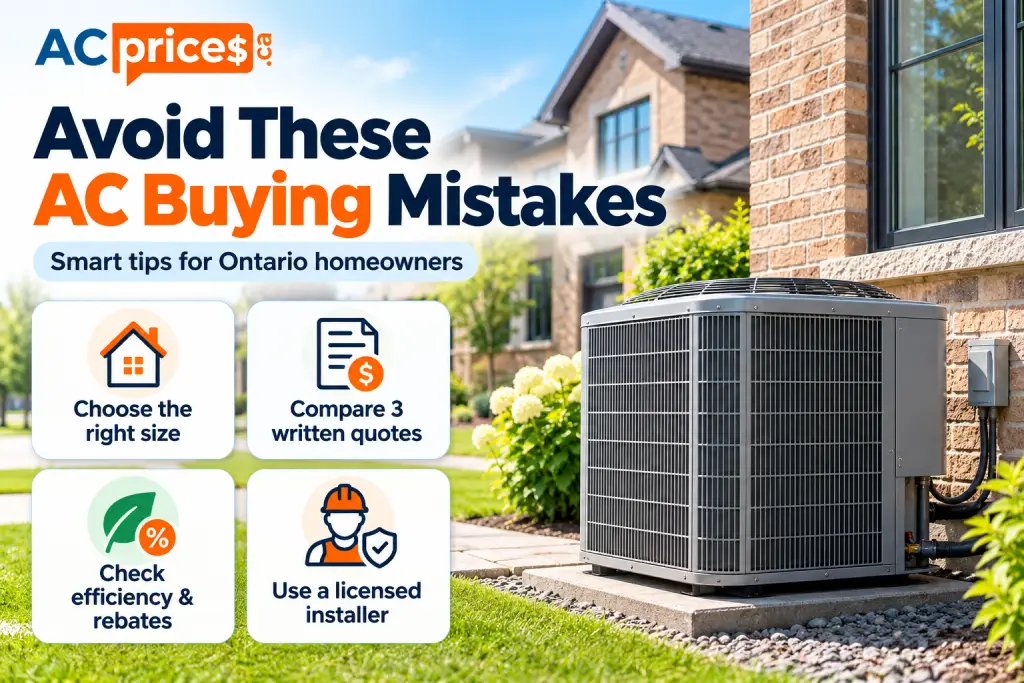
Avoid costly air conditioner buying mistakes by choosing the right size, comparing quotes, checking efficiency and hiring a licensed HVAC installer.
Air conditioner buying mistakes are easy to make because most homeowners replace their cooling system only every 10–12 years. That gap makes it hard to know what to look for or how to compare your options. And since a new air conditioner is a major home investment, one poor decision can cost you comfort and money for a decade.
Across Canada, especially in Ontario, where summers are humid, homeowners keep falling into the same traps. A unit that fails in the middle of a heat wave, pushy sales tactics, and a lack of independent information make air conditioner buying mistakes even more likely. If you understand them beforehand, you can avoid unnecessary expenses, performance problems, and future headaches.
An air conditioner runs for 10 to 12 years or more, so air conditioner buying mistakes follow you through hundreds of hot days. A unit in the wrong size wastes electricity every summer. A quote that hides ductwork surprises you on installation day. Fortunately, most air conditioner buying mistakes come from a handful of habits: rushing, skipping comparisons, and trusting a single quote.
Last updated: October 2026, by the ACPrices.ca editorial team.
❄️ Replacing Your AC?
Compare Licensed HVAC Contractors Before You Decide
Get free, no-obligation quotes from certified local professionals. Then compare real prices side by side, so you avoid the air conditioner buying mistakes that start with the first number you hear.
One of the most frequent and costly air conditioner buying mistakes is choosing a unit that isn’t the right size for your home. Whether the system is too large or too small, the wrong size means higher energy bills, more maintenance, uneven cooling, and a shorter lifespan.
A unit that’s bigger than necessary cools the home rapidly but shuts off too soon. This constant stopping and starting, known as short cycling, wastes electricity, stresses components, and often leaves the house humid. An undersized system, on the other hand, struggles on warm days, runs continuously, and wears out sooner.
To size the unit correctly, the installer should look at your home’s square footage, layout, insulation quality, window placement, and sun exposure, not just a rough estimate. A proper load calculation gives the most accurate answer.
It’s easy to look at the unit’s price and assume that’s your total investment. In reality, replacing an air conditioner also includes installation, possible electrical upgrades, new refrigerant lines (if needed), and ongoing maintenance.
Prices in Ontario and across Canada vary with home size, efficiency rating, and system type. A quote from a certified contractor gives you the most accurate number. Meanwhile, our Ontario AC installation cost guide and the calculator below give you a reasonable ballpark, so you know what to expect. You can also see how AC installation costs across Ontario cities compare.
💰 Free Cost Calculator
Estimate Your AC Replacement Cost
Enter your home size and system type to see a realistic installed-cost range before a contractor ever visits.
Step 1 of 70%
❄️
Air Conditioner Cost Calculator
How much is adding or upgrading your existing A/C going to cost? Get a new air conditioner price estimate instantly with this short quiz.
What size AC unit do you need (tons)?
1 ton = 12,000 BTU. Most homes need 2–3 tons.
2.5 tons
1 tons5 tons
Which efficiency rating do you prefer (SEER)?
Higher SEER = more efficient = lower energy bills, but higher upfront cost.
Do you need additional ductwork installation?
Do you need installation included?
Do you want a smart thermostat included?
Do you want noise reduction upgrade?
Would you like to receive a free no-obligation estimate from our local contractor partners as well?
Great! Almost done, your result is on the next page.
Please enter your contact details so our Certified contractors can provide estimates as well.
This field is required.
Please enter a valid email address.
Please enter your phone number.
Please enter your city or postal code.
By submitting this form, you are giving your consent to receive phone calls and text messages from our contractor partners.
You're almost done!
Please provide your details to see your results.
Name is required.
Email is required.
Please enter your city or postal code.
❄️ Estimate Ready
Your Air Conditioner Cost Estimate
Equipment Cost
—
Total Estimated Cost
—
Get Accurate Quotes from Local Pros
These are estimates. Get precise quotes from certified HVAC contractors in your area — for free.
This estimate excludes unusual ductwork changes, major electrical upgrades, and premium equipment. Treat it as a starting point, not a final quote.
Don’t overlook what happens after the install, either. Regular servicing keeps an air conditioner efficient and helps it last, so ask each contractor about the maintenance schedule, what a yearly tune-up costs, and whether skipping service could affect your warranty.
Seeing the full financial picture early prevents surprises and makes it easier to compare estimates with confidence. Ignoring the full cost is one of the air conditioner buying mistakes that hurts most after you sign.
3. Ignoring Energy Efficiency Ratings
Every new air conditioner sold in Canada carries a SEER (Seasonal Energy Efficiency Ratio) rating that tells you how efficiently the system uses electricity. The higher the SEER rating, the less energy the AC needs to cool your home.
Higher-efficiency models cost more upfront, but they can cut monthly hydro bills significantly, especially in provinces like Ontario where summer cooling demand runs high.
If lowering long-term energy use is a priority, a more efficient model can pay off for many years. Ignoring efficiency ratings is one of the quieter air conditioner buying mistakes, because the cost shows up on every hydro bill.
4. Not Comparing Multiple Quotes
When a cooling system fails, it’s tempting to accept the first estimate you receive. However, comparing your options can save you money and help you find better service agreements.
Request at least three written quotes from licensed HVAC companies. When you review each estimate, look beyond the total price. Compare:
Warranty details
Efficiency ratings
Installation requirements
Expected timelines
What’s included and what may cost extra
Multiple estimates also show you typical pricing in your area and help you decide which company offers the best overall value, not just the lowest number. Skipping this step is among the most common air conditioner buying mistakes.
💡 Pro Insight: Ask every contractor to break their quote into the same lines: equipment, labour, electrical, ductwork, permits, and warranty. When the quotes follow the same layout, a lower price either turns out to be a real saving or shows you exactly what the contractor left out.
5. Choosing the Cheapest Option Instead of the Best Value
It’s natural to gravitate toward the lowest price, especially when you replace a system unexpectedly. However, the cheapest unit can cost more over time through higher energy bills, more frequent repairs, or a shorter lifespan.
Research how different models perform in real Canadian homes. Customer reviews and expert comparisons show how well a system holds up after years of regular use. Compressor type, build quality, and warranty coverage all affect long-term costs.
Be especially careful with lesser-known or low-priced brands that look like a bargain on paper. They can bring higher repair costs and weaker efficiency, so favour reliable brands with solid warranties and local service support.
Often, spending a little more upfront buys you a quieter system, fewer service calls, and lower hydro bills. Those savings add up over the life of your air conditioner.
6. Not Doing Enough Research Before Buying
Because AC replacements are rare, most homeowners don’t know modern cooling technologies, efficiency differences, or how much proper installation matters. Learning the basics prevents costly mistakes.
A bit of research goes a long way. Read up on features like:
Single-stage vs. two-stage compressors
Variable-speed fans
Noise levels
Durability ratings
SEER improvements over older models
You don’t need to become an HVAC expert. Understanding the main terms helps you ask the right questions and feel confident when you compare systems.
Research matters most when your AC dies in the middle of July. Pressure to decide within a day or two leads homeowners to accept the first quote or whichever unit is in stock. If you can, start comparing before the hottest weeks arrive, and read our guide to the best time to buy an AC in Ontario.
Doing your homework also gets you a system that suits your home, instead of relying only on sales recommendations.
🔧 Free Tools
Size Your AC and Check Running Costs Before You Talk to a Contractor
Use our free AC Size & Tonnage Calculator to estimate the capacity your home needs. Then use the AC Operating Cost Calculator to see what a more efficient model could save you each month.
Some air conditioners run more quietly than others. If your outdoor unit sits near a bedroom window, a backyard patio, or a neighbour’s property, noise makes a noticeable difference in comfort.
Manufacturers list sound ratings, often in decibels. In Canada, many homeowners prefer outdoor units that run around 7.6 bels (or lower) for quieter performance.
A system that cools efficiently without unnecessary noise creates a more pleasant home, both inside and out. If you’re sensitive to sound, make noise level a key part of your comparison.
8. Hiring Someone Who Isn’t Fully Licensed
A good air conditioner is only half the equation. Installation quality has a huge impact on performance, efficiency, and lifespan. Poor installation can cause refrigerant leaks, reduced cooling capacity, higher hydro bills, and even warranty denial.
Always choose a licensed HVAC company whose technicians follow Canadian safety codes and manufacturer guidelines. A certified installer will:
Confirm correct system sizing
Ensure refrigerant levels and airflow are properly calibrated
Test the system for efficiency and safety
Protect your warranty
Licensing is the starting point, not the whole check. Ask how the company installs, who will be on site, and whether they have experience with the model you’re buying. Even the best system underperforms when a crew that doesn’t know the equipment rushes the install.
DIY installs and unlicensed labour often cost far more in repairs and system damage. Professional installation is one of the most worthwhile investments in the whole process, and skipping it is one of the costliest air conditioner buying mistakes.
⚠️ Avoid This Mistake: Don’t treat a much lower quote as a win until you know why it’s lower. The gap often comes from missing permits, ductwork, electrical work, or proper start-up testing. Ask the contractor to confirm in writing what the quote includes and what it leaves out.
If you need help getting started, you can compare quotes from certified contractors in your region to find a reliable installer.
9. Forgetting to Check for Rebates
Rebates can make high-efficiency air conditioners much more affordable. Many homeowners don’t know about the incentives available through:
Provincial and federal programs
Local utilities
Energy-efficiency organizations
Manufacturers
Financial institutions
Some rebates require pre-approval before installation, so look into them early. Rebates can lower your upfront cost and may even let you step up to a more efficient model that saves more energy long term.
Check what each program covers before you count on it. As of October 2026, Ontario’s Home Renovation Savings Program pays rebates on heat pumps, not on standalone central air conditioners. Programs change often, so confirm current details on the program’s own website instead of relying on a quote, an older article, or a salesperson. Also ask each contractor whether they’re registered with the program you plan to use.
Before you commit, review current AC rebates in your area so you don’t miss out on savings.
10. Getting Only One Estimate for Installation
As with equipment, comparing installation estimates is essential. Even if you’ve already chosen the air conditioner you want, different HVAC companies offer different pricing, workmanship guarantees, and service packages.
Request at least three installation quotes from licensed professionals. Each estimate should include:
Labour costs
Materials
Timeline
Warranty information
Any additional recommended upgrades
A written project summary
Multiple offers show you what’s standard and what’s unusual, so you can decide with more information and avoid overpriced or incomplete proposals.
You can request free quotes from local certified contractors to make the process easier. Relying on a single installation estimate is one of the simplest air conditioner buying mistakes to avoid.
📋 Get Quotes You Can Actually Compare
Free Quotes from Licensed Local Contractors
Tell us about your home and we’ll connect you with certified HVAC professionals who can quote the same job. That makes comparing them easy and helps you avoid air conditioner buying mistakes.
A new air conditioner is only as good as its fit with the house it serves. Many homeowners shop by the old unit’s size or a rough square-footage rule and never look at the home as a whole.
Several things change how much cooling a house needs:
Insulation levels in the attic and walls
Window size, quality, and which direction they face
Sun exposure and shade from trees or neighbouring buildings
Ceiling heights, open layouts, and finished basements
Air leakage, plus rooms you added or renovated since the last system went in
Ask the installer to assess the whole house and give you a proper load calculation (in Canada, installers follow the CSA F280 standard) instead of copying the old unit’s capacity. The result also shows whether central AC, a heat pump, or a ductless system fits best, and it makes mistake #1 much less likely. Natural Resources Canada explains why sizing matters for heat pumps too, and our heat pump size and BTU calculator gives a quick estimate.
Skipping the whole-house assessment is one of the easiest air conditioner buying mistakes to make.
12. Neglecting Your Ductwork
Your ducts deliver the cooling. A new, efficient air conditioner connected to leaky, undersized, or poorly insulated ducts won’t perform the way its rating suggests, and you’ll pay for cool air that never reaches the room.
Before you sign, ask the contractor to inspect the existing ductwork and look for:
Visible gaps, disconnected sections, or poorly sealed joints
Missing insulation where ducts run through the attic or crawl space
Duct sizing that matches the airflow of the new unit
Rooms that run hotter or colder than the rest of the house
Sealing or modifying ducts can add to the project cost, so ask the contractor to itemize it in the quote up front instead of adding it after work starts. Overlooked ductwork is one of the air conditioner buying mistakes that no thermostat can fix.
13. Believing All Models Are the Same
Two air conditioners with the same tonnage can perform very differently. Technology, efficiency, noise, humidity control, and build quality vary a lot between models and brands, and those differences show up in your comfort and your hydro bill for years.
Compare models like for like. These are the points that matter most:
What to Compare
Why It Matters
Compressor type
Single-stage, two-stage, and variable-speed units differ in comfort, humidity control, and efficiency
Efficiency rating
A higher SEER rating usually means lower running costs, at a higher purchase price
Sound rating
Outdoor unit noise affects bedrooms, patios, and neighbours
Warranty terms
Coverage length and what the warranty includes (parts, compressor, labour) vary by brand and installer
Local service support
A good brand is harder to live with if nobody nearby can service it
Spend an hour on this comparison before you talk to contractors. Then the quotes you receive are much easier to read, and you avoid assuming that every model performs alike.
🛠️ Free Recommendation Wizard
Which AC System Fits Your Home?
Answer a few quick questions about your home’s size, ductwork, and budget to get a clear system recommendation. No phone number required.
Step 1 of 110%
🏆
AC Recommendation Wizard
Which air conditioner should you buy? Find out which air conditioning system is ideal for your home, needs, and budget.
What region do you live in?
How large is your home?
How well insulated is your home?
How often do you run your AC in the summer?
How important is energy efficiency to you?
What is your budget preference?
How long are you planning on staying in your home?
Do you want smart/advanced features?
Do you have central ductwork?
How many people live in your home?
Would you like to receive a free no-obligation estimate from our local contractor partners as well?
Great! Almost done, your result is on the next page.
Please enter your contact details so our Certified contractors can provide estimates as well.
This field is required.
Please enter a valid email address.
Please enter your phone number.
Please enter your city or postal code.
By submitting this form, you are giving your consent to receive phone calls and text messages from our contractor partners.
You're almost done!
Please provide your details to see your results.
Name is required.
Email is required.
Please enter your city or postal code.
🏆 Recommendation Ready
Your Recommended AC System
Best Match For You
—
Get Expert Advice & Free Quotes
A certified HVAC contractor can confirm the best unit for your specific home and climate.
This is a starting recommendation based on the information you provide. A contractor should confirm system choice and sizing with a proper load calculation.
14. Underestimating Smart Technology
Programmable and smart thermostats let you schedule cooling around when you’re actually home, adjust the temperature from your phone, and see how often the system runs. Many homeowners skip these features when they choose a unit, then wish they had them the first hot week.
Treat smart controls as a comfort and convenience feature first. Savings depend on your habits and your system, so nobody can guarantee them. When you compare models, ask:
Does the system work with standard smart thermostats, or only the manufacturer’s own?
Does the thermostat cost extra, and does the quote include installation?
Do any app features sit behind a subscription?
15. Neglecting Warranty Options
Many homeowners compare price and efficiency, then never read the warranty. Usually you need to check two: the manufacturer’s warranty on the equipment, and the installer’s warranty on the workmanship.
Get both in writing and ask:
How long does each warranty last, and what does it cover (parts only, or labour too)?
What could void it, such as skipped maintenance or an unlicensed installer?
Do you need to register the equipment, and by when?
Does the warranty transfer if you sell the house?
Knowing what the warranty covers, and for how long, protects you from unexpected repair bills years down the line. If the contractor offers an extended plan, compare its cost with what it actually adds.
16. Ignoring Future Needs
A new air conditioner should last 10 to 12 years or more, so think about how your home may change over that time. A system chosen only for today’s house can fall short later.
Consider whether any of these are likely:
A growing family or more people working from home
A renovation, addition, or finished basement
A future switch to a heat pump for heating as well as cooling
Selling the home within a few years
Tell your contractor your plans before they size the system. A more flexible setup, such as a two-stage or variable-speed unit with ductwork that leaves room to grow, can cost a little more now and save a costly rework later. If a heat pump is on your list, read our Ontario heat pump installation cost guide and take the Is a Heat Pump Worth It? quiz.
💰 Heat Pump Cost Calculator
Thinking About a Heat Pump Later? See What It Costs
Enter your home size to compare what a heat pump might cost, so you can plan ahead and choose capacity and ductwork that keep your options open.
Step 1 of 60%
❄️
Heat Pump Cost Calculator
How much will a new heat pump cost you? Get an instant price estimate based on your home and needs — takes under 2 minutes.
What type of heat pump are you looking for?
What efficiency level are you considering?
Higher HSPF = more efficient = lower bills, but higher upfront cost.
How large is your home (sq ft)?
This helps estimate the right capacity unit for your home.
1,500 sq ft
500 sq ft4,000 sq ft
Do you need installation included?
Does your home have existing ductwork?
Would you like a free quote from a local certified contractor?
Great! Almost done, your result is on the next page.
Please enter your contact details so our certified contractors can provide accurate quotes.
This field is required.
Please enter a valid email address.
Please enter your phone number.
Please enter your city or postal code.
By submitting this form, you are giving your consent to receive phone calls and text messages from our contractor partners.
You're almost done! Where do we send the results?
Please provide your details to see your results.
Name is required.
Email is required.
Please enter your city or postal code.
❄️ Estimate Ready
Your Heat Pump Cost Estimate
Equipment Cost
—
Total Estimated Cost
—
Get Accurate Quotes from Local Pros
These are estimates. Get precise quotes from certified HVAC contractors in your area — for free.
This estimate is a starting point. Heat pump prices depend on your electrical panel, ductwork, and the system you choose.
Heat Pump vs. Air Conditioner: Avoid the Wrong Choice
One of the newer air conditioner buying mistakes is buying a cooling-only unit without asking whether a heat pump fits your home better. A heat pump cools like an air conditioner in summer, then reverses in winter to heat your home. For many Ontario households, that can mean one system instead of two.
A heat pump is not right for every house. The answer depends on your current heating fuel, your insulation, your ductwork, and your electrical panel. Ask each contractor to quote both options, so you can compare the full cost of cooling and heating together.
Air conditioner only: usually the lower upfront price if your furnace is still in good shape
Heat pump: costs more upfront, but it also heats, and rebates may apply in some cases
Cold-climate heat pump: ask about performance at low outdoor temperatures if you plan to rely on it in winter
Backup heat: ask whether you need to keep your furnace or add electric backup
Check your electricity bill or use the Canadian average.
$0.14 per kWh
$0.08/kWh$0.40/kWh
💡 Canadian average: ~$0.14/kWh. Ontario: ~$0.13, BC: ~$0.12, AB: ~$0.18
Would you like a free no-obligation estimate from local contractor partners?
Great! Almost done, your result is on the next page.
Please enter your contact details so our Certified contractors can provide estimates as well.
This field is required.
Please enter a valid email address.
Please enter your phone number.
Please enter your city or postal code.
By submitting this form, you are giving your consent to receive phone calls and text messages from our contractor partners.
You're almost done!
Please provide your details to see your results.
Name is required.
Email is required.
Please enter your city or postal code.
🌡️ ESTIMATE READY
Your Heat Pump Operating Cost Estimate
Monthly Heating Cost (est.)
—/month
Monthly Cooling Cost (est.)
—/month
Annual Heating Cost
—
Annual Cooling Cost
—
Total Annual Cost
—
Your Electricity Rate
—
IMPORTANT: This is a general estimate for informational purposes only. Actual costs vary based on usage patterns, local weather, thermostat settings, and equipment age.
Get Accurate Quotes from Local Pros
These are estimates. Get precise quotes from certified contractors — for free.
Actual costs depend on your electricity rates, your home, and how you use the system.
Before You Sign: A Checklist to Avoid Air Conditioner Buying Mistakes
Run through this list before you sign. Each point answers one of the air conditioner buying mistakes above.
I have a written load calculation for my whole house, not just the old unit’s size.
I have at least three itemized quotes that cover the same equipment and work.
The quote shows the full cost: equipment, installation, electrical, ductwork, and permits.
I compared efficiency, noise, and compressor type across models.
The installer is licensed, has experience with this model, and gives a written workmanship warranty.
I asked for both an air conditioner quote and a heat pump quote, and compared the full cost.
I checked current rebates and whether the contractor is registered for them.
I thought about how my home may change over the next 10 years.
Staying Comfortable: Putting These AC Buying Tips Into Practice
Now that you know the most common air conditioner buying mistakes, you can choose a system that keeps your home comfortable, efficient, and cost-effective for years to come. Take your time, do your research, and consult professionals before you decide.
Doing a bit of research, comparing quotes, checking rebate options, and choosing a reputable installer are the key steps that protect your investment.
If you’d like more guidance on choosing the right AC for your home, ACPrices.ca offers resources, comparison tools, and contractor directories to help you make informed decisions.
FAQs About Air Conditioner Buying Mistakes
Which air conditioner buying mistakes cost homeowners the most?
Choosing the wrong size is one of the most frequent and costly air conditioner buying mistakes. A unit that is too big short cycles and leaves the house humid, while one that is too small runs constantly and wears out sooner. Hiring an unlicensed installer and accepting a single quote also cost homeowners a lot.
How many quotes should I get for a new AC?
Request at least three written quotes from licensed HVAC companies. Ask each one to itemize equipment, labour, electrical work, ductwork, permits, and warranty so you can compare the offers fairly.
What SEER rating should I look for?
For most Canadian households, a SEER rating between 16 and 18 often gives the best balance between efficiency and cost. Ultra-high-efficiency units exist, but the extra cost may not pay off.
Do I need new ductwork with a new air conditioner?
Not always, but you should have the existing ducts inspected. Leaky, undersized, or uninsulated ducts reduce performance, and sealing or modifying them can add to the cost, so ask the contractor to itemize it in the quote.
Can I install a new air conditioner myself?
We don’t recommend it. Poor or unlicensed installation can cause refrigerant leaks, reduced cooling, higher hydro bills, and warranty denial. Hiring a licensed HVAC company is one of the most worthwhile parts of the purchase.
Are there rebates for a new air conditioner in Ontario?
Incentives can come from provincial and federal programs, local utilities, manufacturers, and financial institutions. Programs and amounts change, and some need pre-approval before installation, so confirm current details on the program’s own website first.
📌 When Are You Planning to Install a New AC?
Let us know your preferred timeline so we can match you with the right local professionals:
We help homeowners across Ontario and Canada review cooling options, compare installation costs, and connect with dependable HVAC companies. Frequently supported service areas include:
These variables help you budget accurately for your project.
📞 Thinking About Installing a New AC?
Compare Estimates from Nearby HVAC Professionals
Find the best fit for your home. Get fast, no-obligation quotes from certified local contractors, and use what you learned here to compare them with confidence and avoid costly air conditioner buying mistakes.
 Canadian