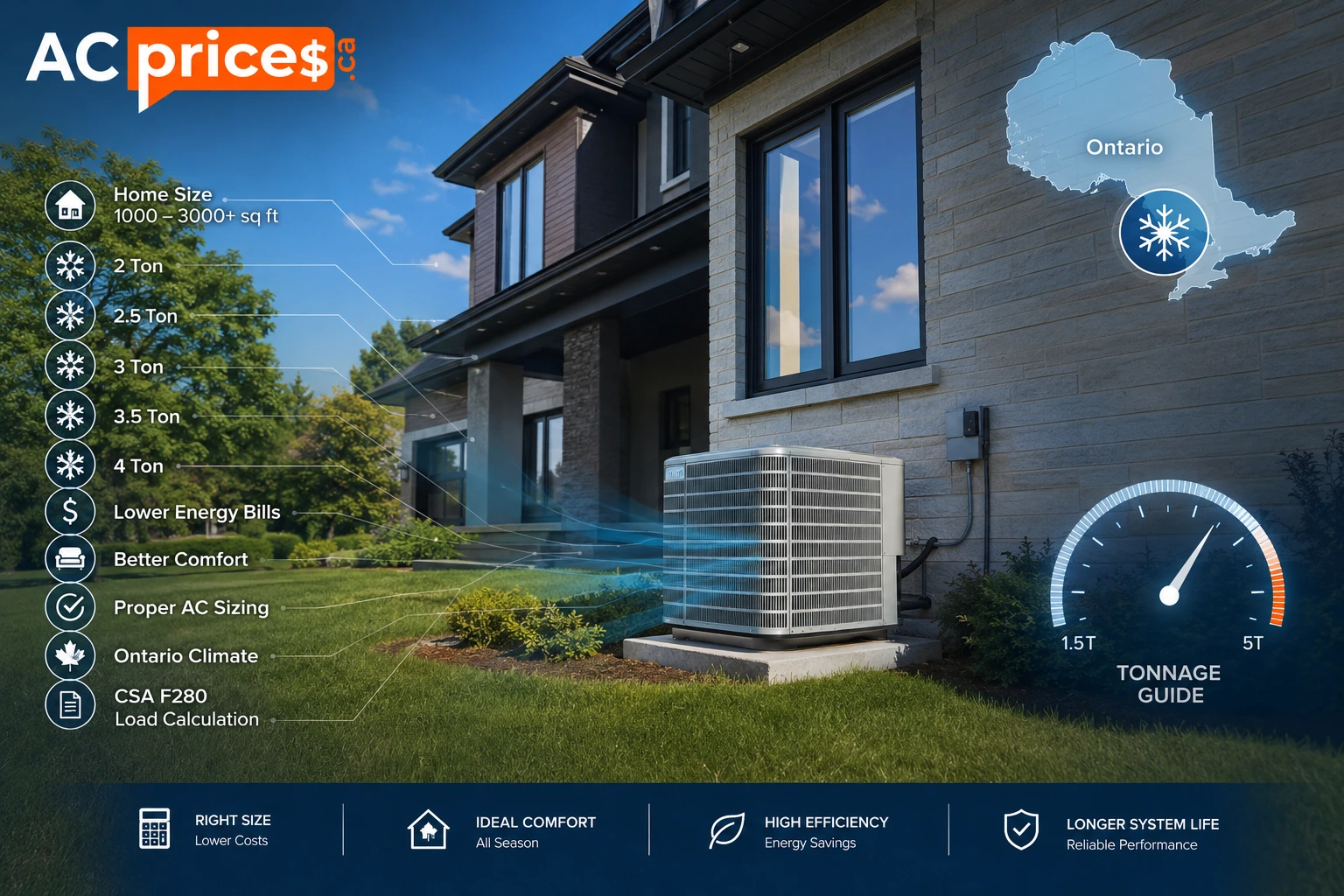
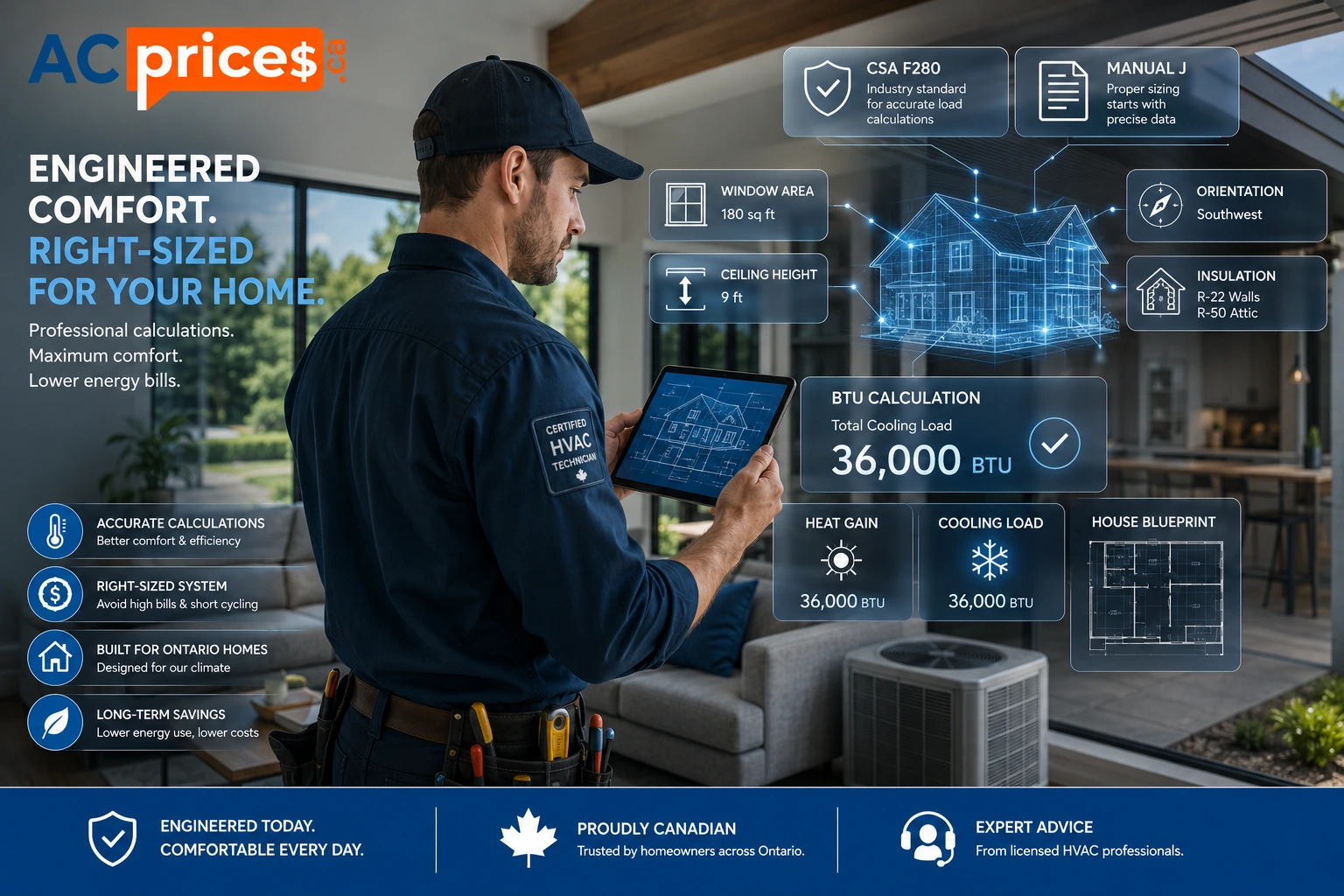
Quick answer: Most Ontario homes need 1.5–5 tons of cooling capacity. As a starting point: 1,000–1,500 sq ft = 2–2.5 tons, 1,500–2,000 sq ft = 2.5–3 tons, 2,000–2,500 sq ft = 3–3.5 tons, 2,500–3,000 sq ft = 3.5–4 tons, 3,000+ sq ft = 4–5+ tons (often split into zones). Insulation, windows, and layout can shift this by half a ton in either direction — a Manual J load calculation gives the exact number for your home.
Choosing the best AC size for home Ontario is one of the most critical decisions you’ll make when installing or replacing your air conditioning system. Many homeowners assume that bigger is always better, but an oversized or undersized AC unit can lead to skyrocketing energy bills, inconsistent temperatures, and premature system failure.
In Ontario’s unique climate—where summers can be hot and humid while winters are bitterly cold—getting the right tonnage for your home isn’t just about comfort; it’s about efficiency, longevity, and cost savings. This guide will help you understand exactly how to match your AC size to your home’s square footage, insulation quality, and cooling needs, so you can avoid costly mistakes and enjoy reliable comfort all summer long.
Whether you’re debating between a 2-ton and 3-ton unit or wondering why your current AC is cycling on and off too frequently, you’ll find expert insights and actionable advice here.
Why Wrong AC Size Increases Bills and Causes Problems
Installing an air conditioner that’s too large or too small for your Ontario home creates a cascade of problems that go far beyond discomfort.
The Cost of an Oversized AC Unit
Choosing the best AC size for home Ontario conditions is critical for comfort and efficiency. When an air conditioner is too powerful for your space, it cools the home too quickly and shuts off before properly removing moisture from the air. While the temperature may feel comfortable, Ontario’s humid summers can leave your home feeling damp and clammy due to poor dehumidification.
Oversized units also short cycle—turning on and off repeatedly throughout the day. Each startup uses a surge of electricity, which drives up your energy bills significantly. Additionally, frequent cycling puts excessive wear on the compressor and other components, shortening the lifespan of your system and leading to expensive repairs or premature replacement.
Sensible Heat vs. Latent Heat: The Real Reason Oversized ACs Feel Clammy
To understand why an oversized AC leaves a house feeling damp, it helps to know that your air conditioner is actually doing two separate jobs:
Sensible cooling — lowering the air temperature (what your thermostat measures)
Latent cooling — removing moisture from the air, by condensing water vapour on the cold evaporator coil
On a humid Ontario afternoon, the latent load can account for 20–30% of the total cooling load. A correctly sized AC runs long, steady cycles — typically 15 to 30 minutes — which gives the coil time to stay cold long enough for meaningful condensation to occur and drain away.
An oversized unit satisfies the sensible load almost immediately: it drops the air near the thermostat to the set temperature within 5–10 minutes and shuts off. The coil never stays cold long enough to handle the latent load. The result is a home where the thermostat reads a comfortable 22°C, but the air still feels damp — because the moisture was never actually removed.
Signs this is happening in your own home:
Indoor humidity feels high even though the thermostat is satisfied
Condensation on windows or cold water pipes on humid days
A musty smell in the basement or closets
Bedrooms feel clammy overnight even with the AC running
The permanent fix is correct sizing. If you’re stuck with an oversized system already installed, a whole-home dehumidifier on the return duct (roughly $1,200–$2,500 installed) or a two-stage/variable-speed compressor — which can run at reduced capacity for longer cycles — both help mitigate the problem without a full replacement.
The Hidden Costs of an Undersized AC Unit
On the other hand, an undersized air conditioner struggles to keep up with cooling demand. It runs continuously during hot days, working overtime without ever reaching your desired temperature. This constant operation not only spikes your hydro bills but also stresses the system, increasing the likelihood of breakdowns during peak summer heat.
When the system isn’t properly sized, you’ll notice hot spots in certain rooms, inconsistent temperatures between floors, and difficulty maintaining comfort during heat waves—exactly when choosing the best AC size for home Ontario conditions matters most.
Energy Efficiency and SEER Ratings Take a Hit
Even if you invest in a high-efficiency air conditioner with an excellent SEER rating, improper sizing negates those benefits. A correctly sized unit operates within its optimal efficiency range, while a poorly sized system wastes energy regardless of its technical specifications.
💡 Not sure if your current AC is properly sized? A CSA F280 (or Manual J) load calculation removes the guesswork and ensures you invest in the right system from the start.
Understanding AC Sizing: What Does “Tonnage” Actually Mean?
AC tonnage has nothing to do with weight. Instead, it measures cooling capacity—specifically, how much heat the system can remove from your home in one hour.
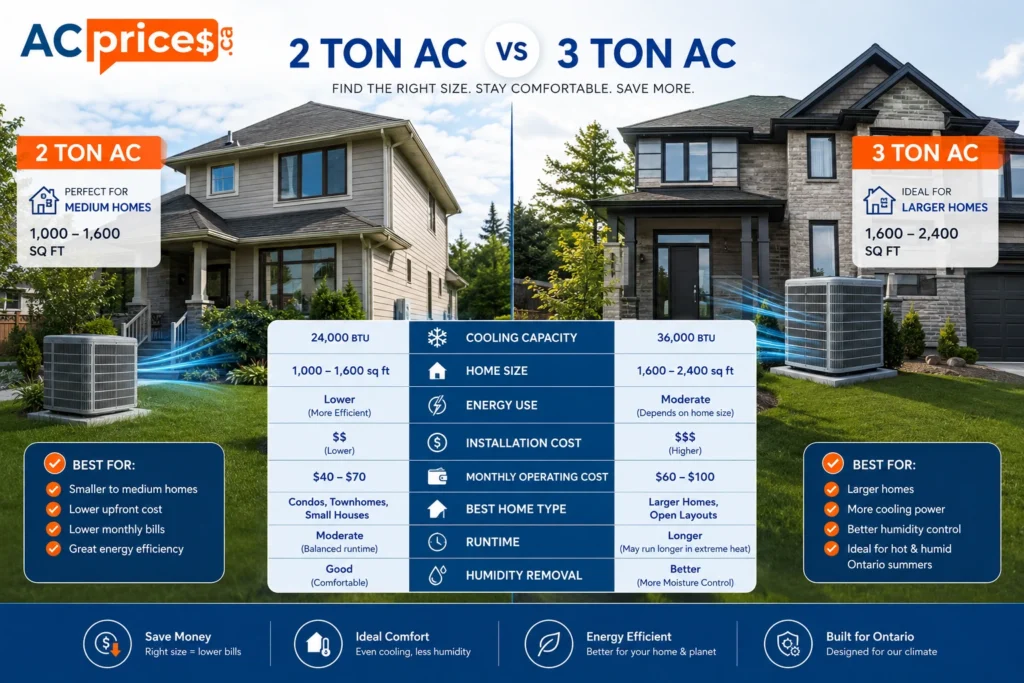
One ton of cooling equals 12,000 BTUs (British Thermal Units) per hour. So a 2-ton AC can remove 24,000 BTUs/hour, while a 3-ton unit handles 36,000 BTUs/hour.
Most Ontario homes require between 1.5 and 5 tons of cooling capacity, depending on size, insulation, and other factors. The key is matching your system’s capacity to your home’s actual cooling load—not just guessing based on square footage alone.
AC Tonnage Chart Ontario: Square Footage Guidelines
While square footage is a starting point, it’s not the only factor. Here’s a comprehensive AC size by square footage Ontario guide:
Ontario AC Sizing Chart
Home Size (sq ft)
Recommended Tonnage
BTU/Hour
Typical Home Type
Up to 1,000
1.5 – 2 tons
18,000 – 24,000
Small bungalow, condo
1,000 – 1,500
2 – 2.5 tons
24,000 – 30,000
Medium bungalow, townhouse
1,500 – 2,000
2.5 – 3 tons
30,000 – 36,000
Large bungalow, 2-story home
2,000 – 2,500
3 – 3.5 tons
36,000 – 42,000
Large 2-story, split-level
2,500 – 3,000
3.5 – 4 tons
42,000 – 48,000
Executive home, open concept
3,000+
4 – 5+ tons
48,000+
Large estate, multi-zone
Note: These are general guidelines. Actual requirements vary based on insulation, windows, orientation, and regional climate.
Why Square Footage Alone Isn’t Enough
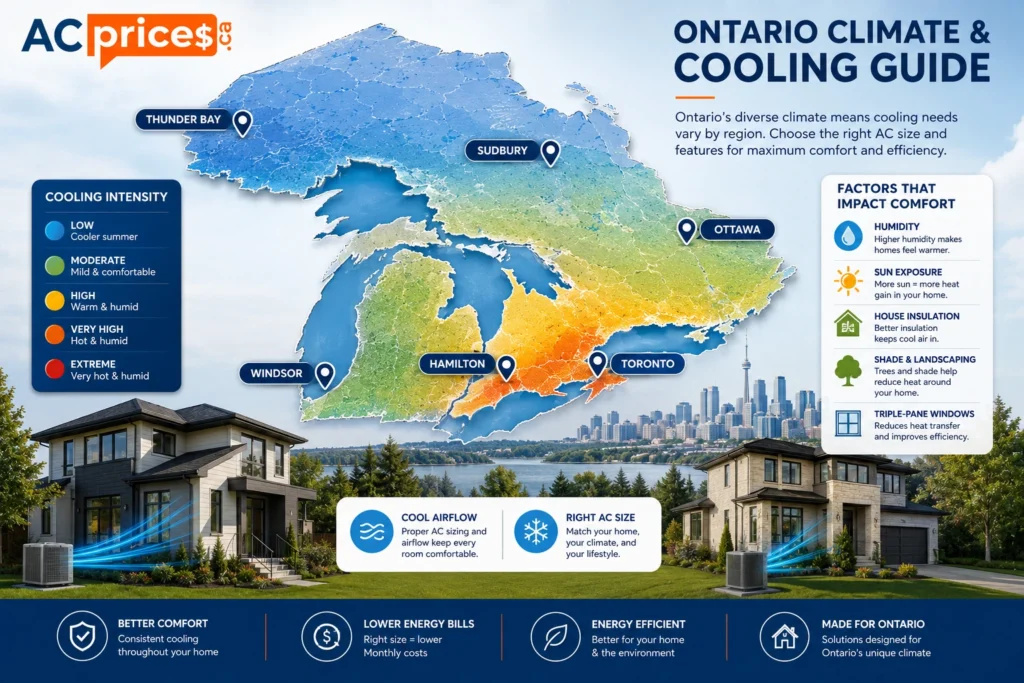
Ontario’s climate varies significantly by region, meaning a home in Windsor faces very different cooling demands than one in Thunder Bay or Ottawa. Beyond location, factors such as ceiling height, number of windows, sun exposure, and insulation quality all play a role in determining the best AC size for home Ontario conditions and calculating an accurate cooling load..
Professional HVAC contractors use CSA F280 (or the equivalent Manual J) load calculations a detailed assessment that accounts for all these variables to determine the precise AC size your home needs.
What Size Air Conditioner Do I Need?
Homeowners often search by their exact home size rather than a range. Here’s how common Ontario home sizes map to tonnage, assuming average insulation:
1,000 sq ft: 1.5–2 tons
1,500 sq ft: 2–2.5 tons
1,800 sq ft: 2.5–3 tons
1,900 sq ft: 2.5–3 tons
2,000 sq ft: 3 tons
2,100 sq ft: 3 tons
2,200 sq ft: 3–3.5 tons
2,400 sq ft: 3.5 tons
2,500 sq ft: 3.5–4 tons
3,000 sq ft: 4–4.5 tons
These are starting points, not final answers — two homes of the same square footage can need different tonnage depending on ceiling height, window area, and insulation. Use the AC Size & Tonnage Calculator to get a number specific to your home in under a minute.
Step 1 of 30%
📐
A/C Size Calculator
This short quiz is designed to help homeowners estimate the correct central air conditioning system size and BTU rating for your home.
Select your home type
Approximate home square footage of finished living space
Would you like to receive a free no-obligation estimate from our local contractor partners as well?
Great! Almost done, your result is on the next page.
Please enter your contact details so our Certified contractors can provide estimates as well.
This field is required.
Please enter a valid email address.
Please enter your phone number.
Please enter your city or postal code.
By submitting this form, you are giving your consent to receive phone calls and text messages from our contractor partners.
You're almost done!
Please provide your details to see your results.
Name is required.
Email is required.
Please enter your city or postal code.
📐 Size Calculated
Your Recommended AC Size
Recommended Tonnage
—
BTU Output
—
Get a Confirmed Size from a Pro
A certified HVAC contractor performs a Manual J load calculation for exact sizing.
Well-insulated homes with energy-efficient windows
Single-story homes or bungalows with minimal sun exposure
Homes with proper attic ventilation and modern roofing
A properly sized 2-ton AC runs longer cycles, which improves dehumidification and energy efficiency. It also costs less upfront and consumes less electricity during operation.
When to Upgrade to a 3-Ton AC
A 3-ton unit (36,000 BTU/hour) is better suited for:
Larger homes (1,700–2,200 sq ft)
Two-story homes with multiple zones
Older homes with poor insulation or single-pane windows
Homes with large west or south-facing windows
Open-concept layouts with high ceilings
Homes in hotter regions of Ontario (like southwestern Ontario)
If your current 2-ton system struggles to maintain temperature during July and August, or if you've added square footage through renovations, upgrading to 3 tons might be necessary.
The Middle Ground: 2.5-Ton Systems
Many HVAC professionals recommend 2.5-ton units for borderline cases. This size offers a balanced approach, providing adequate cooling without the risk of oversizing.
💡 Quick Decision Guide:
1,800 sq ft in GTA with poor insulation → likely 2.5–3 tons
1,500 sq ft bungalow with new windows → likely 2–2.5 tons
2,000 sq ft 2-story with finished basement → likely 3–3.5 tons
Climate and Insulation: Ontario-Specific Factors
Ontario's climate presents unique challenges for AC sizing. Summer temperatures regularly hit 30°C (86°F) with high humidity, while older homes often lack modern insulation standards.
Regional Climate Variations
Southern Ontario (GTA, Hamilton, Windsor): Hotter, more humid summers require slightly larger AC units or systems with enhanced dehumidification
Northern Ontario (Thunder Bay, Sudbury): Shorter cooling seasons mean you can sometimes size down without sacrificing comfort
Ottawa Valley: Temperature swings and humidity make proper sizing critical for both comfort and efficiency
Niagara Region: Proximity to water affects humidity levels and cooling needs
Insulation's Impact on AC Size
A home with R-50 attic insulation, R-20 walls, and triple-pane windows might need 20-30% less cooling capacity than an identical home with minimal insulation. Air sealing also plays a massive role—drafty homes lose cool air quickly, forcing your AC to work harder.
Before sizing your AC, consider investing in:
Attic insulation upgrades (minimum R-50 recommended for Ontario)
Air sealing around windows and doors
Window treatments or UV-blocking film for sun-facing windows
Proper attic ventilation
These improvements can allow you to install a smaller, more efficient AC unit while improving overall comfort.
Not Sure If a Heat Pump Makes Sense for You Yet?
🏠
Is a Heat Pump Worth It? Quiz
Answer 5 quick questions and find out if switching to a heat pump makes sense for your home, climate, and lifestyle.
Step 1 of 520%
How do you primarily heat your home currently?
Do you have ductwork and heating vents in your home?
Central duct systems allow for a ducted heat pump. Without ducts, a ductless mini-split is still an option but at higher cost.
Which region do you live in?
Heat pumps perform best in moderate climates. Cold-climate models now work well even in very cold regions.
How well insulated is your home?
How long are you planning on staying in your home?
A heat pump is a long-term investment. Longer stays mean better return on investment.
Would you like a free no-obligation estimate from local contractor partners?
Great! Almost done, your result is on the next page.
Please enter your contact details so our certified contractors can provide estimates.
This field is required.
Please enter a valid email address.
Please enter your phone number.
Please enter your city or postal code.
By submitting this form, you are giving your consent to receive phone calls and text messages from our contractor partners.
You're almost done!
Please provide your details to see your results.
Name is required.
Email is required.
Please enter your city or postal code.
🏠 RESULTS READY
—
—
—
Your Score
—
Max Possible
10 pts
Heating System
—
Region Suitability
—
Key factors from your answers
—
Note: This quiz provides a general recommendation. A certified HVAC contractor can assess your specific home and provide a tailored recommendation.
Get a Free Quote from Local Pros
Find out exactly how much a heat pump would cost for your home — for free.
Understanding how different factors combine helps you make better decisions. Here are real-world scenarios from Ontario cities:
Toronto Example: 1,650 sq ft Semi-Detached (East York)
Home Details:
Built 1975, upgraded insulation (R-40 attic)
South-facing backyard with large windows
2 stories + finished basement
Original System: 2-ton (struggled in July/August) Recommended: 2.5-ton with enhanced dehumidification Result: 18% reduction in cooling costs, consistent comfort
Ottawa Example: 2,100 sq ft 2-Story (Kanata)
Home Details:
Built 2005, good insulation
Many windows, open-concept main floor
High ceilings in living room
Recommendation: 3-ton system Why: Open layout + high ceilings + large window area = higher cooling load despite good insulation
Hamilton Example: 1,400 sq ft Bungalow (Westdale)
Home Details:
Built 1960, minimal insulation upgrades
Single-pane windows
Mature trees provide shade
Original thought: 2.5 tons due to poor insulation Professional recommendation: 2 tons after Manual J calculation Key factor: Shade from trees reduced cooling load significantly
Mississauga Example: 2,800 sq ft Executive Home (Erin Mills)
Home Details:
Built 2018, exceptional insulation
Energy-efficient windows throughout
2 zones (upper/lower)
Recommendation: 3.5-ton main + 2-ton secondary for upper floor Why: Two-zone system provides better efficiency than single 5-ton unit
Signs Your AC Is Oversized or Undersized
Not sure which category your AC falls into? Run the free AC Troubleshooting Wizard to check your symptoms, or get matched with a licensed Ontario HVAC contractor for a load calculation.
Step 1 of 50%
🔍
AC Troubleshooting Wizard
Which AC issue are you having? Answer a few quick questions to help identify the most likely cause of your air conditioner problem and what to do next.
When you check your thermostat, what do you notice?
What sound do you hear from your AC unit?
How is the airflow from your vents?
When did you last have professional maintenance?
Would you like to receive a free no-obligation estimate from our local contractor partners as well?
Great! Almost done, your result is on the next page.
Please enter your contact details so our Certified contractors can provide estimates as well.
This field is required.
Please enter a valid email address.
Please enter your phone number.
Please enter your city or postal code.
By submitting this form, you are giving your consent to receive phone calls and text messages from our contractor partners.
You're almost done!
Please provide your details to see your results.
Name is required.
Email is required.
Please enter your city or postal code.
🔍 Diagnosis Ready
AC Troubleshooting Results
Most Likely Cause
—
Get a Certified Tech to Confirm
Our diagnosis is a starting point. A certified HVAC technician can confirm the issue and fix it right the first time.
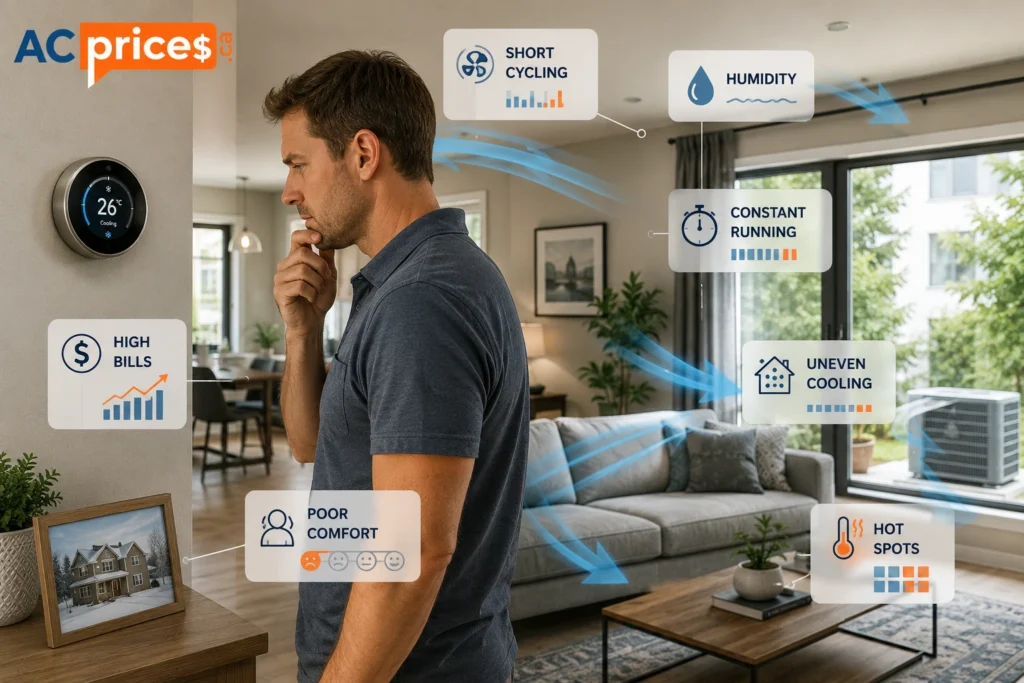
Short cycling: The unit turns on and off every 5–10 minutes
High humidity indoors: Your home feels damp or sticky even when the AC is running
Temperature swings: Rooms get too cold quickly, then warm up again
High energy bills: Despite minimal runtime, your hydro costs are excessive
Uneven cooling: Some rooms are freezing while others remain warm
Your AC Is Too Small If:
Constant operation: The system runs non-stop during hot days without reaching set temperature
Hot spots: Certain rooms never get comfortable
Inability to cool during peak heat: Your home can't maintain 22°C (72°F) on hot afternoons
Frequent repairs: The system is overworked and breaks down regularly
Rising energy costs: Continuous operation drives up electricity usage
If you're experiencing any of these issues, it's time for a professional load calculation and potentially a system replacement.
Not sure which category your AC falls into? Run the free AC Troubleshooting Wizard to check your symptoms, or get matched with a licensed Ontario HVAC contractor for a load calculation.
How to Calculate the Right AC Size: CSA F280-12 Load Calculation
The only accurate way to determine the best AC size for home Ontario is through a CSA F280-12 load calculation Canada's reference standard, equivalent to the Manual J method. In Ontario, the official standard for this is CSA F280-12, mandated by the Ontario Building Code for new construction and major retrofits. You may also hear contractors refer to "Manual J," which is the equivalent American standard published by the Air Conditioning Contractors of America. The two methods produce very similar results — what matters is that a real load calculation is performed, not which name appears on the report.
A CSA F280 (or Manual J) assessment inputs more than 30 variables across several categories, including:
Local climate data and summer/winter design temperatures for your region
Wall, roof, floor, and foundation insulation levels (R-values)
Window area, orientation, and solar heat gain
Air leakage (infiltration) through the building envelope
Occupancy and appliance heat gains
Duct location and losses (unconditioned attic vs. conditioned basement)
The output is a whole-home cooling load in BTU/hour. Divide that by 12,000 to get the required tonnage. A properly matched system should fall within roughly 85–115% of that calculated load — anything further outside that range, in either direction, is a sizing red flag worth questioning your contractor about.
Why "Rules of Thumb" Fail — Especially on Newer Homes
Older sizing shortcuts like "one ton per 500 square feet" were calibrated for 1950s–60s housing stock: single-pane windows, R-10 walls, R-20 attics, and leaky envelopes. Modern Ontario homes built to current code (Ontario Building Code SB-12) have much better insulation and airtightness. Applying an old rule of thumb to a modern home routinely oversizes it by 30–50% — which is a large part of why oversized systems are so common in Ontario. Always ask to see the actual load calculation, not just a quoted tonnage.
Additional Factors That Affect AC Sizing in Ontario
Number of Occupants
More people generate more body heat. A family of five produces significantly more internal heat gain than a couple, requiring a slightly larger AC unit.
Appliances and Electronics
Kitchens with commercial-grade appliances, home offices with multiple computers, or entertainment rooms with large TVs all add to your cooling load.
Basement Inclusion
If you're cooling a finished basement in addition to main floors, you'll need more capacity. However, basements naturally stay cooler, so they don't require proportional tonnage increases.
Future Renovations
Planning to finish your attic or add a sunroom? Consider these future changes when sizing your AC to avoid replacing the system again in a few years.
The Role of SEER2 Rating and Energy Efficiency
Once you've determined the right tonnage, focus on efficiency. As of 2023, the industry standard shifted from SEER to SEER2, which uses more realistic testing conditions to measure how much cooling a unit delivers per watt-hour of electricity. Canada harmonizes its efficiency testing and minimums with this updated standard, and the current minimum for new systems sold here is 13.4 SEER2, roughly equivalent to the old SEER 14 rating.
For most Ontario homes, SEER2 16–18 is the practical sweet spot: enough efficiency gain to notice on your hydro bill, without the steep price jump of SEER2 20+ systems. Homes with high cooling demand — large south-facing windows, open-concept layouts, or longer cooling seasons in southwestern Ontario — tend to see the fastest payback from going higher.
One important distinction: SEER2 does not change the tonnage your home needs. A 3-ton, SEER2-14 unit and a 3-ton, SEER2-20 unit both remove exactly 36,000 BTU/hour — the higher-rated unit just does it using less electricity. Size the tonnage first, from your load calculation. Choose the SEER2 rating second, based on your electricity rates, how long you plan to stay in the home, and available rebates.
A properly sized SEER2-14 unit will outperform an oversized SEER2-20 unit every time. Size matters more than efficiency rating when it comes to comfort and long-term cost
See What Your SEER2 Rating Costs You Monthly
Step 1 of 70%
⚡
Air Conditioner Operating Cost Calculator
Calculate the estimated monthly and annual operating cost of your air conditioner based on your usage, climate, and electricity rate.
What type of air conditioner do you have?
What is the size of the area you are cooling?
How well insulated is your space?
What is your climate region?
What temperature do you set your thermostat to?
Thermostat setting affects how hard your AC works.
22°C
17°C27°C
What is your average electricity rate? ($/kWh)
Check your electricity bill for your rate. Average is $0.12–$0.15/kWh.
$0.13/kWh
0.07/kWh0.3/kWh
Would you like to receive a free no-obligation estimate from our local contractor partners as well?
Great! Almost done, your result is on the next page.
Please enter your contact details so our Certified contractors can provide estimates as well.
This field is required.
Please enter a valid email address.
Please enter your phone number.
Please enter your city or postal code.
By submitting this form, you are giving your consent to receive phone calls and text messages from our contractor partners.
You're almost done!
Please provide your details to see your results.
Name is required.
Email is required.
Please enter your city or postal code.
⚡ Costs Calculated
Your AC Operating Costs
Monthly Cost
—
Annual Cost
—
Reduce Your Energy Costs
A properly sized, high-efficiency AC keeps operating costs low. Get free quotes from certified contractors.
Even perfectly sized equipment will underperform if installed poorly. Ensure your contractor:
Properly sizes and seals ductwork
Tests refrigerant charge precisely
Verifies airflow measurements
Checks for air leaks in the system
Programs thermostats correctly
Provides written documentation of all work
Poor installation can reduce efficiency by 20-30% and void manufacturer warranties.
Important: Work only with licensed, WSIB-insured contractors who follow TSSA (Technical Standards and Safety Authority) regulations for Ontario installations.
Considering a Heat Pump Instead? Sizing Works a Little Differently
Many Ontario homeowners now weigh a cold-climate heat pump against a traditional central AC, partly due to provincial and federal rebate incentives. On the cooling side, sizing works the same way: a 3-ton heat pump provides the same 36,000 BTU/hour of cooling as a 3-ton AC, using the same load calculation.
The difference is on the heating side. A heat pump's heating capacity drops as outdoor temperatures fall, so a unit sized correctly for summer cooling will typically need backup heat — usually your existing furnace or an electric element — for the coldest 50–100 hours of an Ontario winter. If you're comparing a heat pump to a straight AC replacement, it's worth getting both cooling and heating load calculations before deciding, since sizing purely off your home's cooling needs can leave you under-heated on the coldest days of the year.
If you're comparing a heat pump to a straight AC replacement, it's worth getting both cooling and heating load calculations before deciding, since sizing purely off your home's cooling needs can leave you under-heated on the coldest days of the year.
Step 1 of 50%
📐
Heat Pump Size & BTU Calculator
Find the right heat pump capacity for your home. Get your recommended BTU output in under 2 minutes.
What is your home's square footage?
1,500 sq ft
500 sq ft5,000 sq ft
What climate zone do you live in?
Climate affects how much heating and cooling capacity you need.
How well insulated is your home?
What are your ceiling heights?
Would you like a free quote from a local certified contractor?
Almost done! Your BTU recommendation is on the next page.
Enter your details so certified contractors can follow up with an accurate quote.
This field is required.
Please enter a valid email address.
Please enter your phone number.
Please enter your city or postal code.
By submitting this form, you are giving your consent to receive phone calls and text messages from our contractor partners.
You're almost done!
Please provide your details to see your results.
Name is required.
Email is required.
Please enter your city or postal code.
📐 Size Calculated
Your Recommended Heat Pump Size
Recommended BTU
—
Tonnage
—
Get a Confirmed Size from a Pro
A proper Manual J load calculation by a certified HVAC contractor ensures perfect sizing for your home.
1. What size AC do I need for a 1,500 sq ft home in Ontario?
Most 1,500 sq ft homes in Ontario require a 2 to 2.5-ton AC unit. However, factors like insulation quality, number of windows, home layout, and sun exposure can shift this recommendation. A professional Manual J load calculation will provide the most accurate sizing for your specific home. Homes in the GTA with poor insulation may need 2.5 tons, while well-insulated bungalows might only need 2 tons.
2. Is a 3-ton AC too big for a 2,000 sq ft house in Ontario?
Not necessarily. A well-insulated 2,000 sq ft bungalow might only need 2.5 tons, while a two-story home with poor insulation and large windows could require a full 3 tons. The key is proper load calculation—square footage alone doesn't determine the right size. Ontario's humid climate also affects sizing, particularly in southern regions like Toronto, Hamilton, and Windsor.
3. Can I save money by installing a smaller AC unit?
Installing an undersized unit to save on upfront costs will cost you far more in energy bills, repairs, and premature replacement. A properly sized system costs less to operate and lasts longer, making it the smarter financial choice. In Ontario's climate, an undersized AC will struggle during July and August heat waves, running constantly and driving up hydro bills.
4. Does Ontario's climate require special AC sizing considerations?
Yes. Ontario's humid summers and variable regional temperatures mean proper dehumidification and capacity are critical. Homes in southwestern Ontario (Windsor, London, Hamilton) typically need slightly more capacity than those in northern regions (Sudbury, Thunder Bay) due to longer, hotter cooling seasons. Ottawa and the GTA require sizing that accounts for both heat and high humidity levels.
5. What is a CSA F280 load calculation and why do I need it?
CSA F280-12 is Canada's reference standard method for determining exact AC sizing (equivalent to Manual J). It factors in your home's square footage, insulation, windows, orientation, occupancy, and local climate data to calculate precise cooling requirements. This calculation ensures you don't over-spend on an oversized unit or under-invest in one that can't keep up. All reputable Ontario HVAC contractors should provide this before installation.
6. What size air conditioner do I need?
Most Ontario homes need between 1.5 and 5 tons of cooling capacity, based mainly on square footage, insulation, and layout. Use the sizing chart above or the free calculator for a number specific to your home.
7. What size AC do I need for a house in Toronto, Ottawa, or Hamilton?
The tonnage math is the same across Ontario, but southern cities (Toronto, Hamilton, Windsor, London) and the Ottawa Valley see more humid, longer cooling seasons than northern Ontario, so homes there often size at the higher end of the recommended range for their square footage.
8. Do smaller Ontario towns like Ajax, Milton, or Brantford need different AC sizing than Toronto?
No sizing depends on the home itself (square footage, insulation, windows, orientation), not the town. Nearby towns in southern Ontario share similar climate conditions, so the same tonnage guidelines apply.
9. How do I know if my current AC is the wrong size?
Watch for short cycling (frequent on/off), constant operation without reaching desired temperature, high humidity indoors, uneven cooling between rooms, or dramatically high energy bills. These symptoms indicate either oversizing or undersizing. If you experience any of these issues, request a professional assessment and load calculation (CSA F280 or Manual J).
AC and HVAC Design for Large Ontario Homes (3,000+ sq ft)
Large homes need more than a bigger single unit. Once a home passes roughly 3,000 sq ft, or spans multiple storeys with distinct sun exposure on each side, a single AC struggles to cool every room evenly — even at the "correct" total tonnage.
Common approaches for larger Ontario homes:
Zoned systems: dampers and multiple thermostats let upstairs and downstairs run independently, which matters in two-storey homes where heat rises and upper floors run hotter.
Dual systems: a separate, smaller unit for an addition, finished basement, or upper floor instead of oversizing one central unit.
Ductless mini-splits as a supplement: useful for a sunroom, bonus room, or finished attic that the main ductwork doesn't reach well.
Because large homes rarely have uniform cooling loads room to room, a Manual J calculation matters even more here than in a smaller bungalow — total tonnage alone won't tell you where to put the capacity.
Conclusion: Get Your AC Sizing Right the First Time
Selecting the best AC size for home Ontario isn't about guessing or following outdated rules of thumb. It requires understanding your home's unique characteristics, Ontario's climate demands, and the science behind proper load calculations.
An oversized unit wastes energy through short cycling and poor dehumidification, while an undersized system runs continuously without achieving comfort. Both scenarios lead to higher bills, frequent repairs, and shortened equipment life.
The smartest approach is working with a qualified HVAC professional who performs a detailed Manual J calculation, considers your home's insulation and layout, and recommends equipment sized precisely for your needs—whether you're in Toronto, Ottawa, Hamilton, or anywhere across Ontario.
Don't let improper AC sizing cost you thousands in wasted energy and premature replacements. Invest the time to get it right from the start, and you'll enjoy reliable comfort and lower bills for 15-20 years.
Get a free, no-obligation AC sizing assessment from licensed Ontario HVAC professionals.
Our certified, WSIB-insured technicians will:
Perform a comprehensive CSA F280 (Manual J–equivalent) load calculation
Assess your home's insulation and cooling challenges
Provide honest recommendations tailored to your budget
Explain rebate eligibility (Enbridge)
No pressure, just expert guidance
Contact us today for your free AC sizing check and discover how the right-sized system can save you hundreds on energy bills while keeping your Ontario home comfortable all summer long.
Step 1 of 80%
💚
New Air Conditioner Savings Calculator
How much can you save by upgrading your air conditioner? Get an instant estimate of your potential annual electricity cost savings.
What is the size of your home?
How would you rate your home's insulation & windows?
How many months per year do you use your AC?
Hours per day you run your AC (on average)
How old is your current central air conditioner?
The SEER rating of older units is used to calculate your current running costs.
What type of new AC are you considering?
What is your average electricity rate? ($/kWh)
Check your electricity bill. Average is $0.12–$0.15/kWh.
$0.13/kWh
0.07/kWh0.3/kWh
Would you like to receive a free no-obligation estimate from our local contractor partners as well?
Great! Almost done, your result is on the next page.
Please enter your contact details so our Certified contractors can provide estimates as well.
This field is required.
Please enter a valid email address.
Please enter your phone number.
Please enter your city or postal code.
By submitting this form, you are giving your consent to receive phone calls and text messages from our contractor partners.
You're almost done!
Please provide your details to see your results.
Name is required.
Email is required.
Please enter your city or postal code.
💚 Savings Calculated
Your Potential AC Savings
Annual Savings
—
Payback Period
—
Current Annual Cost
—
New Annual Cost
—
Start Saving — Get Free Quotes
These are estimates. Certified HVAC contractors can give you accurate savings projections based on your home.
Have questions about selecting or sizing your next air conditioner? Our expert-backed guides and local contractor directory can help you make a confident decision. Visit acprices.ca to learn more or request free quotes from certified installers near you.
📌 When Are You Planning to Install a New AC?
Let us know your preferred timeline so we can match you with the right local professionals:
Our network of certified contractors covers most major Canadian regions, offering support whether you’re replacing an older system or evaluating new AC models.
 Canadian